.svg)

How to Build an Effective Employee Engagement Plan | Guide 2026
.svg)
.svg)
Download our comprehensive framework with 50+ assessment criteria, scoring methodology, and action planning worksheets.
Download E-bookHow to Create an Employee Engagement Plan - Steps & Strategies
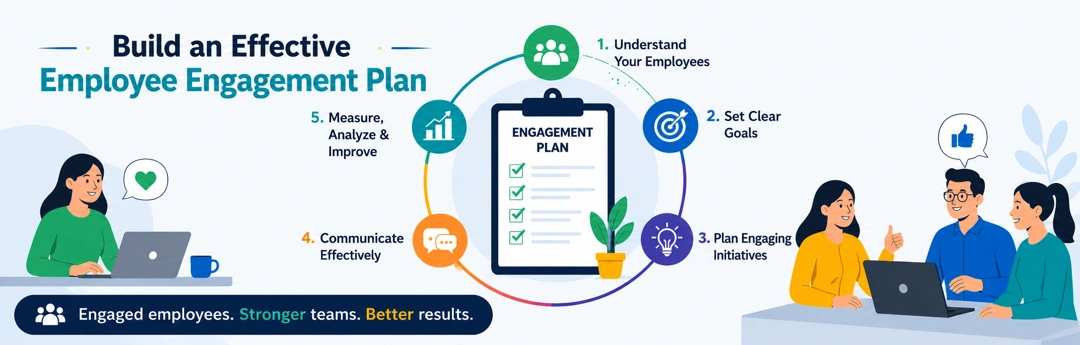
An employee engagement plan is a structured, measurable approach to understanding what helps employees do their best work, identifying what blocks engagement, and converting those insights into action. For HR leaders, CEOs, CHROs, business heads, and managers, the practical answer is simple: start with diagnosis, prioritise the few drivers that matter most, assign ownership, act visibly, measure progress, and close the feedback loop.
In 2026, an employee engagement action plan cannot be a calendar of fun activities, annual surveys, or isolated HR initiatives. It has to be a business-aligned system that connects culture, manager effectiveness, employee listening, recognition, wellbeing, DEI, retention, and performance. Gallup defines employee engagement as “the involvement and enthusiasm of employees in both their work and workplace,” and notes that highly engaged teams outperform others on outcomes that matter to organisational success.
For India-based and global organisations, the need is sharper. Hybrid work, distributed teams, rapid AI adoption, cost pressure, manager burnout, skills gaps, and rising employee expectations have made engagement more dynamic than ever. Gartner’s 2026 HR priorities highlight AI transformation, workforce redesign, leadership mobilisation, and embedding culture to drive performance as major CHRO concerns.
The goal of this guide is to help you build an employee engagement plan that is practical enough for managers, credible enough for leadership, and measurable enough for HR analytics.
What is an employee engagement plan?
An employee engagement plan is a structured roadmap that helps an organisation improve employee commitment, motivation, connection, and performance by acting on evidence from feedback, culture analytics, people data, and business priorities.
A strong plan answers five questions:
An employee engagement plan is not a one-time HR document. It is an operating rhythm. It uses employee listening, pulse surveys, recognition data, performance conversations, manager check-ins, and culture intelligence to make better people decisions.
AIHR’s guidance on engagement planning focuses on structured diagnosis, clear goals, stakeholder alignment, and measurable initiatives rather than vague “engagement activities.” Deel similarly frames an engagement plan as a process of assessing current engagement, gathering feedback, designing actions, measuring progress, and sustaining improvement.
What to do next
Before writing initiatives, define the problem precisely. For example, “low engagement” is not specific enough. A sharper problem statement could be:
“Mid-level engineers in Bengaluru and Gurgaon report low career clarity, weak manager feedback, and limited recognition. Attrition in this group is 1.8x the company average.”
That kind of diagnosis leads to a better employee engagement action plan than generic morale-building activities. An employee engagement plan is a disciplined way to move from feedback to action. The best plans are diagnostic-first, outcome-driven, and owned by both HR and business leaders.
Engagement vs satisfaction, culture vs climate, measurement vs transformation
Many engagement plans fail because organisations use important terms interchangeably. HR leaders should distinguish these clearly.
Engagement vs satisfaction
Employee satisfaction measures how content employees are with aspects of work such as compensation, policies, facilities, flexibility, or workload.
Employee engagement measures the emotional and behavioural connection employees have with their work, team, manager, and organisation.
A satisfied employee may be comfortable but not necessarily committed. An engaged employee is more likely to contribute discretionary effort, speak up, collaborate, and stay through change.
Culture vs climate
Culture is the deeper system of values, beliefs, behaviours, rituals, and norms that shape how work gets done.
Climate is how employees experience the organisation right now. Climate can shift quickly after a leadership change, restructuring, return-to-office policy, compensation cycle, or major business event.
A culture health check should examine both. Climate tells you what employees feel now. Culture tells you why those feelings keep repeating.
Measurement vs transformation
Measurement is collecting data. Transformation is changing decisions, behaviours, systems, and leadership routines based on that data.
Annual surveys, dashboards, and analytics do not improve engagement by themselves. Transformation happens when managers have better conversations, leaders make clearer decisions, employees see action, and HR tracks outcomes. Before launching a survey, align leadership on definitions. Decide what you are measuring: satisfaction, engagement, culture, climate, wellbeing, manager effectiveness, DEI, or all of these through distinct lenses. Clear definitions create better data. Better data creates better action. Better action creates trust.
Why employee engagement matters for HR, CEOs, CHROs, BU leaders, and managers
Employee engagement matters because it is one of the clearest people signals connected to retention, performance, customer experience, innovation, wellbeing, and culture health.
For CEOs and business leaders, engagement is not a “soft” metric. It is an early warning system for execution risk. Low engagement can show up as missed deadlines, slow decisions, quality issues, absenteeism, customer dissatisfaction, and attrition.
For CHROs and HRBPs, engagement is a way to connect people strategy with business priorities. It helps HR identify where leadership behaviour, work design, recognition, manager capability, or career development is affecting outcomes.
For managers, engagement is the day-to-day reality of whether teams feel clear, trusted, supported, recognised, and able to do meaningful work.
SHRM’s work on employee engagement in the new era of work frames engagement as a priority for organisational success, particularly as work models, employee expectations, and technology continue to evolve. McKinsey’s HR Monitor 2025 also identifies employee experience as a strategic priority for engagement and retention.
Why this matters in India
In India, engagement is especially important because many organisations are managing fast growth, young workforces, hybrid teams, high talent mobility, regional diversity, global delivery expectations, and pressure to retain critical skills. Employees increasingly compare their experience not only with local peers but also with global employers.
For Indian HR teams, an employee engagement plan should account for:
What to do next
Link engagement to a visible business challenge. For example:
- Reduce regrettable attrition in high-skill roles
- Improve manager effectiveness after rapid scaling
- Strengthen belonging in hybrid teams
- Improve retention and performance through culture
- Build a stronger recognition culture
- Improve trust after organisational change
Engagement matters because it explains how culture is affecting execution. When treated strategically, it becomes a business intelligence system for people's decisions.
Why employee engagement plans are critical in 2026
In 2026, employee engagement plans are critical because organisations are facing more change, more data, more AI, more manager pressure, and less tolerance for performative HR activity.
Several trends are reshaping engagement.
1. Engagement is becoming more dynamic
A once-a-year survey is too slow for today’s workplace. Organisational restructuring, AI rollouts, policy changes, leadership transitions, and market uncertainty can shift employee sentiment within weeks.
Qualtrics’ 2026 Employee Experience Trends research highlights disruptive AI adoption, change fatigue, and hidden costs of cost-cutting as major forces shaping employee experience.
2. AI is changing how work feels
AI can improve productivity, but it can also create anxiety, role ambiguity, trust concerns, and uneven adoption. Gartner lists AI transformation and workforce redesign in the human-machine era among top 2026 HR priorities.
An employee engagement strategic plan must therefore measure whether employees feel equipped, included, and confident in AI-led change.
3. Managers are under pressure
Many engagement problems are manager-mediated. Employees experience strategy through their manager. If managers are unclear, overloaded, undertrained, or disengaged, team engagement suffers.
Gallup’s 2026 workplace coverage points to manager engagement and development as important themes in the broader decline in global employee engagement.
4. Employees expect listening and action
Employees are less tolerant of feedback exercises that do not lead to visible change. Qualtrics reported that engagement is nearly twice as high when employers increased listening, and employees are more than twice as likely to say action gets taken when employers listen more.
5. Culture is now a performance lever
Culture cannot sit in values posters or onboarding decks. It has to show up in decisions, rituals, manager behaviour, recognition, communication, performance systems, and leadership accountability.
Move from an annual engagement calendar to a continuous listening and action system. Combine deep engagement surveys with short pulse surveys, manager check-ins, exit data, performance metrics, and culture analytics. In 2026, the organisations that win on engagement will not be the ones that survey more. They will be the ones that diagnose better, act faster, and build trust through visible follow-through.
Why organisations need employee feedback tools inside the engagement plan
Organisations need employee feedback tools because engagement cannot be managed through assumptions, anecdotal feedback, or leadership intuition alone.
A modern employee engagement plan needs reliable data from different levels of the organisation. Employee feedback tools help HR and leaders capture signals from employees, understand patterns, prioritise action, and track whether interventions are working.
Without feedback tools, common problems emerge:
McKinsey’s work on continuous employee listening emphasises the role of people analytics and ongoing listening in supporting data-driven decisions on talent issues.
What to do next
Use feedback tools to answer specific business and culture questions, not simply to collect more data. For example:
- Which teams are at risk of attrition?
- Are managers effective one-on-one?
- Do employees understand strategy?
- Is recognition fairly distributed?
- Are hybrid employees feeling included?
- Are new joiners losing engagement after onboarding?
- Are employees confident about AI adoption?
- Are high performers seeing a future here?
Employee feedback tools matter because they turn employee voice into structured intelligence. But tools only create value when connected to action.
What is an employee feedback tool?
An employee feedback tool is a digital platform that helps organisations collect, analyse, and act on employee input through surveys, pulse checks, anonymous feedback, sentiment analytics, manager dashboards, recognition signals, and action planning workflows.
A strong feedback tool does more than ask questions. It helps HR and leaders understand what the feedback means, where the biggest issues are, which employee groups are affected, and what actions should be taken.
Definition:
An employee feedback tool is a system for converting employee voice into actionable insight, helping organisations identify engagement drivers, culture risks, manager effectiveness gaps, and opportunities to improve retention and performance.
Employee feedback tools may include:
- Pulse surveys
- Annual engagement surveys
- Employee lifecycle surveys
- Anonymous feedback channels
- Manager feedback dashboards
- eNPS tracking
- Culture analytics
- Recognition and appreciation tools
- Action planning modules
- AI-assisted sentiment analysis
- Integration with HRMS, collaboration, and performance systems
Employee feedback tool vs employee engagement survey software
Pulse survey vs engagement survey
What to do next
Use different feedback methods for different decisions. Do not ask a 60-question survey when a five-question pulse will do. Do not rely on a pulse survey when you need a deep culture health check. An employee feedback tool is useful only when it helps people leaders separate signal from noise and move from insight to action.
Key benefits of employee feedback tools
Employee feedback tools support an employee engagement plan by making employee voice visible, measurable, and actionable. The main benefits are not just data collection; they are better decisions, faster response, stronger trust, and improved culture health.
1. Two-way communication
Employee feedback tools create a structured channel for employees to share what is working, what is not, and what they need. This matters because engagement improves when employees believe their voice is heard and acted upon.
Two-way communication is not the same as broadcasting updates. It requires listening, responding, clarifying trade-offs, and closing the loop.
What to do next
After every survey or pulse, communicate:
- What we heard
- What we are prioritising
- What we cannot solve immediately
- What managers will discuss with teams
- When employees will see progress
Two-way communication builds trust when employees see that feedback leads to real decisions.
2. Real-time sentiment insight
Real-time sentiment insight helps leaders detect emerging risks before they become attrition, conflict, disengagement, or productivity loss.
For example, a return-to-office policy may be accepted by one team and strongly resisted by another. A single company-wide average can hide important differences by location, role, manager, or life stage.
What to do next
Segment feedback by function, location, tenure, level, manager, and work model, while protecting anonymity. For Indian organisations, also examine differences across metro, tier-2, frontline, corporate, and global delivery teams where relevant. Real-time insight helps HR move from reactive problem-solving to proactive culture management.
3. Continuous performance improvement
Employee engagement is closely linked to whether people have clarity, resources, feedback, recognition, and growth. Feedback tools help identify performance blockers.
Common performance-related engagement signals include:
What to do next
Connect engagement data with performance conversations, not individual surveillance. The goal is to improve team conditions, not punish employees for sentiment. Feedback tools improve performance when they identify the work conditions that help employees contribute.
4. Engagement and retention
Engagement data can help identify retention risk earlier. Employees often show signs of disconnection before they resign: lower advocacy, weaker intent to stay, reduced trust in leadership, poor manager relationship, lack of growth, or low recognition.
McKinsey’s HR Monitor frames employee experience as a strategic priority for engagement and retention, especially as HR leaders align people strategy with business change.
What to do next
Track engagement alongside attrition, internal mobility, manager changes, compensation cycles, career progression, and workload. Avoid treating retention as only a compensation problem. Retention improves when organisations address the conditions that make employees want to stay, grow, and contribute.
5. Data-driven people decisions
Feedback tools help HR leaders make evidence-based decisions about people strategy. Instead of guessing which initiatives matter, HR can identify the strongest engagement drivers.
For example, if survey analysis shows that career growth is the top driver of intent to stay for early-career employees in India, while manager trust is the top driver for senior professionals in the UK, the organisation can design targeted actions instead of global one-size-fits-all programmes.
What to do next
Use driver analysis, heatmaps, cohort comparison, and trend data. Look for patterns, not isolated comments. Data-driven HR does not mean removing judgement. It means improving judgement with better evidence.
6. Recognition culture
Recognition is one of the most practical ways to improve engagement. Employees want to know that their work is seen, valued, and connected to organisational goals.
A recognition culture is not only about rewards. It includes timely appreciation, peer recognition, manager acknowledgement, leadership visibility, and fair celebration of contributions.
SHRM’s State of the Workplace reporting identifies teamwork, purpose, fairness, and recognition as key drivers of positive employee experience.
What to do next
Measure whether recognition is frequent, fair, specific, and inclusive. Examine whether some teams, levels, genders, locations, or work modes receive less recognition. Recognition improves engagement when it is specific, timely, and connected to meaningful contribution.
7. Manager-employee alignment
Managers are the most important local interpreters of culture. They translate strategy into priorities, feedback, coaching, recognition, and psychological safety.
Employee feedback tools help managers understand where their teams need support. But manager dashboards must be practical. A manager does not need a complex analytics console; they need clear insight, recommended actions, and conversation guides.
What to do next
Give managers team-level insights, three priority actions, and simple team discussion templates. Train them to listen without defensiveness. Engagement improves when managers move from “owning scores” to improving team conditions.
Core features of top employee feedback tools
A top employee feedback tool should support the full engagement cycle: listen, diagnose, prioritise, act, measure, and learn.
1. Pulse and continuous feedback surveys
Pulse surveys help organisations track employee sentiment frequently without overburdening employees. They are useful during change, after policy shifts, during rapid growth, or when leaders need quick insight into a specific issue.
What to look for
- Short, focused survey design
- Recurring pulse cadence
- Question rotation
- Trend tracking
- Team-level reporting
- Survey fatigue controls
What to do next
Use pulse surveys for targeted questions. For example, after a new AI tool rollout, ask whether employees feel trained, supported, clear on expectations, and comfortable raising concerns. Pulse surveys are useful when they are brief, purposeful, and connected to action.
2. Anonymous feedback collection
Anonymity helps employees speak honestly, especially in hierarchical or high-power-distance cultures. This can be particularly important in India, SEA, and MENA contexts where employees may hesitate to challenge managers directly.
What to look for
- Clear anonymity thresholds
- Confidential comment handling
- No reporting for very small groups
- Transparent communication on data use
- Protection against re-identification
What to do next
Explain anonymity rules before the survey. Employees must know what HR can and cannot see. Anonymous feedback works only when employees trust the process.
3. Real-time analytics and reporting
Real-time analytics help HR and leaders identify trends, hotspots, and priority drivers. Good analytics should simplify decisions, not overwhelm users.
What to look for
- Dashboards by function, location, tenure, level, and manager
- Heatmaps
- Trend lines
- Driver analysis
- Comment themes
- Risk indicators
- Exportable leadership summaries
What to do next
Focus leadership reviews on two or three priority insights per business unit, not every metric. Analytics should help leaders decide what to do next.
4. Integration with HR and performance systems
Engagement data becomes more powerful when connected responsibly with HRMS, performance, recognition, learning, and attrition data.
What to look for
- HRMS integration
- SSO
- Slack, Teams, or collaboration integration
- Performance management integration
- Recognition data connection
- Data privacy controls
- Role-based access
What to do next
Decide which integrations are necessary at launch and which can wait. Avoid overbuilding before adoption is proven. Integrations help engagement data become business-relevant, but privacy and governance must be clear.
5. Customisable question libraries
Question libraries help HR teams ask better questions and benchmark consistently. But the tool should allow customisation for industry, geography, workforce type, and organisational context.
What to look for
- Validated engagement questions
- Culture and values questions
- Manager effectiveness questions
- DEI and inclusion questions
- Wellbeing questions
- Lifecycle questions
- India-relevant wording and language flexibility
What to do next
Use a stable core set of questions for trend comparison, then add rotating modules for current priorities. Good questions produce useful data. Poor questions create noise.
6. Actionable alerts and follow-ups
The best employee engagement action plan tool should help teams act, not only measure. Alerts and workflows help HR follow up on risk areas.
What to look for
- Low-score alerts
- Team-level action planning
- Owner assignment
- Due dates
- Progress tracking
- Manager nudges
- Leadership reporting
What to do next
Create rules for escalation. For example, if psychological safety drops significantly in a business unit, HRBP and the BU leader should review the data within two weeks. Action workflows prevent survey insights from becoming forgotten dashboards.
7. Mobile-friendly interfaces
Mobile access is essential for frontline, distributed, retail, manufacturing, logistics, healthcare, education, and field teams. In India and SEA, mobile-first design often determines participation.
What to look for
- Mobile survey completion
- WhatsApp or SMS-compatible communication where appropriate
- Low-bandwidth usability
- Multilingual support
- Simple manager views
What to do next
Test the survey experience with real employees before launch, especially frontline or non-desk workers. If the tool is difficult to access, the data will be biased toward desk employees.
How feedback tools support organisational growth
Feedback tools support organisational growth by helping leaders understand whether the organisation has the culture, capability, trust, and manager effectiveness needed to execute strategy.
Growth creates pressure. Teams scale quickly. Managers are promoted before they are trained. Communication becomes inconsistent. Culture becomes uneven. Employees experience different versions of the same company depending on their manager, location, tenure, or function.
A feedback tool helps identify these patterns early.
Growth challenge and feedback use case
What to do next
Use engagement data in business reviews. Do not keep it inside HR-only dashboards. When leaders review revenue, productivity, customer metrics, or attrition, they should also review the culture and engagement signals that influence those outcomes. Organisational growth is sustainable only when culture scales with the business.
The employee engagement plan framework: 10 practical steps
This is the core framework for building a practical, high-impact employee engagement plan.
Step 1: Define the business objective
Start with the business reason for engagement work. Avoid starting with activities.
Weak objective:
“Improve employee engagement.”
Strong objective:
“Reduce regrettable attrition among high-performing product and engineering employees by improving career clarity, manager feedback, recognition, and internal mobility.”
Your engagement plan should connect to business outcomes such as:
- Retention
- Productivity
- Manager effectiveness
- Customer experience
- Quality
- Innovation
- Safety
- Inclusion
- Performance
- Change adoption
- Culture health
Write one clear business objective for the engagement plan. Then write the people's outcomes that support it. An engagement plan without a business objective becomes a list of HR activities.
Step 2: Build leadership alignment
Senior leaders must agree on why engagement matters, what will be measured, how results will be shared, and what action ownership looks like.
Leadership alignment prevents three common problems:
- Leaders dispute survey results after seeing unfavourable data.
- HR owns all action while business leaders stay passive.
- Managers receive scores without support or accountability.
Run a leadership alignment session before the survey. Agree on:
- Survey purpose
- Confidentiality principles
- Reporting rules
- Action planning expectations
- Communication plan
- Leadership commitments
- Timeline
Leadership alignment is the first engagement intervention.
Step 3: Diagnose current engagement levels
Use multiple listening methods to understand the current state.
Deel recommends assessing current engagement using employee listening sessions, pulse surveys, engagement surveys, performance metrics, and one-on-one feedback.
Do not rely on a single source. Combine quantitative scores with qualitative themes and business data. Good diagnosis prevents wasted effort.
Step 4: Identify engagement drivers
Not all engagement issues have equal impact. Driver analysis helps identify which factors most strongly influence engagement, intent to stay, advocacy, or performance.
Common engagement drivers include:
- Role clarity
- Manager effectiveness
- Trust in leadership
- Recognition
- Growth and career development
- Fairness
- Belonging
- Workload
- Wellbeing
- Purpose
- Collaboration
- Autonomy
- Psychological safety
- Compensation fairness
- Learning opportunities
- Performance feedback
Separate hygiene issues from engagement drivers. Compensation dissatisfaction may be important, but if career growth is the strongest predictor of attrition in one cohort, your action plan must prioritise career clarity. Focus on the drivers that matter most, not the topics that are easiest to discuss.
Step 5: Segment the data carefully
Company-wide averages hide the truth. Engagement is often uneven across locations, managers, functions, tenure groups, demographic groups, or work modes.
For example, the overall engagement score may be 74%, but the reality may look like this:
Segment enough to find patterns, but protect anonymity. Avoid reporting data for very small groups. Engagement action becomes sharper when you know where the issue lives.
Step 6: Prioritise 2–3 focus areas
Trying to fix everything creates no movement. A strong employee engagement strategic plan focuses on a small number of high-impact priorities. Use a simple prioritisation matrix:
Select one enterprise-level priority, one business-unit priority, and one manager-level priority. Prioritisation is what turns engagement from noise into strategy.
Step 7: Create the employee engagement action plan
The action plan should include initiatives, owners, deadlines, communication, resources, and metrics.
A practical format:
Assign business owners, not only HR owners. Engagement is experienced in the business, so action must happen in the business. A good employee engagement action plan is specific enough to be executed and measurable enough to be reviewed.
Step 8: Build team engagement action plans
Company-level action is necessary but not sufficient. Each manager should create a team engagement action plan based on team-level insights.
A manager’s team plan should be simple:
- Discuss results with the team.
- Ask what surprised them.
- Pick one strength to protect.
- Pick one issue to improve.
- Agree on two actions.
- Review progress in 30–45 days.
Give managers a structured conversation guide. Many managers avoid engagement discussions because they fear criticism or do not know how to facilitate the conversation. Engagement improves when teams own local action, not when HR sends company-wide emails.
Step 9: Communicate progress and close the loop
Employees need to know what happened after they gave feedback. Silence damages trust.
Use a communication rhythm:
Publish a “You said, we are doing” summary. Be honest about what will not change and why. Closing the loop is one of the simplest ways to build trust.
Step 10: Measure progress and improve continuously
Engagement planning is a cycle. After action, measure whether conditions improved.
Track:
- Engagement score movement
- Driver score movement
- Participation rates
- Intent to stay
- Manager effectiveness
- Recognition frequency
- Internal mobility
- Attrition
- Absenteeism
- Wellbeing indicators
- Performance outcomes
- Employee comments
- Action completion
Review progress quarterly. Continue what works, adjust what does not, and stop initiatives that create effort without impact. Engagement work becomes credible when HR shows what changed.
What most teams get wrong when creating an employee engagement action plan
Most engagement plans fail for predictable reasons.
1. They start with activities instead of diagnosis
Pizza parties, town halls, wellness days, and contests may have a place, but they do not fix unclear roles, poor managers, unfair recognition, or lack of growth.
2. They over-rely on annual surveys
Annual surveys are useful for deep diagnosis but too slow for fast-changing workplaces. Organisations need a mix of annual, pulse, lifecycle, and always-on feedback.
3. They treat engagement as HR’s job
HR can design the system, but leaders and managers create the employee experience every day.
4. They report scores without context
A low score is not the answer. This is the beginning of the question.
5. They ask for feedback and do not act
This is worse than not asking. Employees remember when organisations collect feedback and disappear.
6. They confuse perks with culture
Perks can support experience, but culture is shaped by decisions, leadership behaviour, work design, fairness, communication, and trust.
7. They ignore manager capability
Many managers are expected to improve engagement without training, time, data literacy, or coaching support.
Audit your previous engagement cycle. Ask:
- Did we act on the top three drivers?
- Did managers discuss results with teams?
- Did employees see visible progress?
- Did leaders review action status?
- Did scores improve where action happened?
- Did we stop low-value activities?
Engagement plans fail when they collect feedback but do not change the conditions employees experience.
Signal vs noise: how to read engagement data properly
Engagement data can mislead if HR teams treat every comment, score, or spike as equally important. The skill is to separate signals from noise.
What is a signal?
Signal is a repeated, meaningful pattern that points to a real organisational issue or opportunity.
Examples:
- Career clarity is low across three high-attrition teams.
- New hires report strong onboarding in month one but lower belonging by month six.
- Managers with high feedback scores also have better retention.
- Employees in one location report consistently lower trust in leadership.
- Recognition is strong overall but weak for remote employees.
What is noise?
Noise is isolated feedback, temporary frustration, or data distortion that may not represent a broader pattern.
Examples:
- One extreme comment with no supporting pattern
- A score drop caused by one recent incident
- Overinterpreting small group data
- Comparing teams with very different contexts
- Treating all low scores as equally urgent
How to separate signal from noise
In leadership reviews, do not present every data point. Present the strongest signals, evidence behind them, business implication, and recommended action. Engagement analytics should not create data theatre. It should help leaders make better decisions.
From insight to action: how to convert survey feedback into measurable change
The hardest part of engagement work is not listening. It is action.
A useful “insight to action” model has five stages:
1. Insight
Identify the pattern.
Example:
Employees in customer success teams report low workload sustainability and low manager support.
2. Interpretation
Understand what the insight means.
Example:
Rapid client escalation, unclear prioritisation, and insufficient staffing are creating burnout risk.
3. Decision
Choose the action.
Example:
Redesign escalation rules, add weekly workload review, train managers on prioritisation conversations, and assess staffing.
4. Execution
Assign owners and timelines.
Example:
BU head owns staffing review. Managers own weekly workload check-ins. HRBP tracks progress.
5. Measurement
Track whether the action worked.
Example:
Workload sustainability improves by 8 points in the next pulse; sick leave and attrition risk decline.
For every insight, write the action in this format:
Because we heard ___, we will ___, owned by ___, by ___, measured by ___.
The value of employee listening is not the dashboard. It is the decision that follows.
Metrics that matter in an employee engagement strategic plan
A strong employee engagement strategic plan includes input, experience, behaviour, and outcome metrics.
Core engagement metrics
Outcome metrics
Leading vs lagging indicators
Create an engagement scorecard with no more than 10 metrics. Include both people and business indicators. The best engagement metrics predict what leaders need to act on, not only what has already happened.
Team engagement action plan template for managers
Managers need a simple, practical template. This version can be used after a team survey or pulse.
Team engagement action plan
Example
Manager conversation guide
Managers can use these questions:
- What result feels most accurate?
- What result surprised you?
- What is one strength we should protect?
- What is one thing we can improve in the next 30 days?
- What do you need from me as your manager?
- What will we commit to as a team?
What to do next
Train managers before giving them results. A good manager's conversation can build trust; a defensive one can damage it. A team engagement action plan should be small, visible, and reviewed quickly.
Employee engagement action plan tool: what to look for
An employee engagement action plan tool helps HR teams and managers convert survey results into structured actions, ownership, follow-up, and measurement.
The best tools help answer:
- What should we prioritise?
- Who owns the action?
- What is the timeline?
- What support does the manager need?
- Has the action been completed?
- Did engagement improve?
- Did the business outcome improve?
Must-have capabilities
Do not buy only dashboards. Buy for decision quality and action adoption. A strong employee engagement action plan tool should reduce the distance between feedback and change.
Examples of employee engagement strategies that work
An employee engagement plan needs strategies that address real engagement drivers. Below are practical strategies HR leaders can adapt.
Strategy 1: Strengthen manager effectiveness
Managers influence clarity, feedback, recognition, workload, career development, and psychological safety.
Actions
- Train managers on one-on-ones
- Create feedback conversation guides
- Build manager coaching circles
- Track team engagement by manager
- Support new managers during their first 90 days
- Include engagement action in manager goals
Start with managers of teams showing low engagement or high attrition risk. Improving manager capability is one of the highest-leverage engagement actions.
Strategy 2: Improve career clarity
Career growth is a major engagement and retention driver, especially in India’s competitive talent market.
Actions
- Publish role expectations
- Create career pathways
- Train managers on career conversations
- Offer internal mobility
- Build skill-based learning plans
- Recognise lateral growth, not only promotions
Run stay interviews with high-performing employees to understand career risk. Employees are more likely to stay when they can see a future inside the organisation.
Strategy 3: Build recognition into everyday work
Recognition should be frequent, specific, fair, and connected to values.
Actions
- Create peer recognition channels
- Train managers to recognise effort and outcomes
- Recognise collaboration, not only heroics
- Review recognition equity across teams
- Connect recognition to company values
Measure recognition frequency and fairness, not only programme participation. Recognition is powerful when it reinforces the culture you want.
Strategy 4: Improve leadership communication
Employees disengage when they do not understand strategy, decisions, or change.
Actions
- Run monthly leadership updates
- Explain the “why” behind decisions
- Create open Q&A channels
- Equip managers with talking points
- Communicate trade-offs honestly
- Close the loop after feedback
Ask employees whether they understand company priorities and trust leadership communication. Clarity is a form of respect.
Strategy 5: Support wellbeing and workload sustainability
Wellbeing is not the only benefit. It is work design.
Actions
- Review workload hotspots
- Reduce unnecessary meetings
- Clarify priorities
- Train managers to spot burnout
- Build escalation norms
- Encourage recovery time after intense cycles
Track workload sustainability by team and role. Do not average it away. Burnout cannot be solved only with wellness webinars.
Strategy 6: Improve belonging and inclusion
Engagement improves when employees feel respected, included, and able to contribute.
Actions
- Measure belonging across cohorts
- Review meeting inclusion
- Train managers on inclusive behaviour
- Support employee resource groups where appropriate
- Audit recognition and growth equity
- Create safe feedback channels
Look for differences across gender, location, tenure, level, work mode, and language groups, while protecting privacy. Belonging becomes real when employees experience fairness in decisions and daily interactions.
Strategy 7: Make hybrid work intentional
Hybrid work requires deliberate design. Without it, employees experience inconsistency, proximity bias, and communication gaps.
Actions
- Define team collaboration norms
- Clarify office purpose
- Train managers on hybrid inclusion
- Measure remote and office experience separately
- Review promotion and recognition equity
- Protect deep work time
Ask employees whether hybrid policies help them collaborate, focus, and feel included. Hybrid work succeeds when flexibility and fairness are designed together.
Strategy 8: Use employee listening during change
Change can energise employees when they understand the purpose and feel supported. It can exhaust them when they feel ignored or overloaded.
Qualtrics’ 2026 research highlights that organisational change is not automatically negative; employee support and listening determine whether change is energising or draining.
Actions
- Run change readiness pulses
- Identify anxiety themes
- Train managers to answer questions
- Create feedback loops during rollout
- Track confidence and clarity
- Act quickly on adoption blockers
For major AI, restructuring, or policy changes, run a pulse before, during, and after implementation. Employees do not resist all change. They resist unclear, unsupported, or unfair change.
Examples of employee feedback and engagement tools in 2026
The following platforms are brands worth considering when evaluating employee feedback tools, employee engagement survey software, culture analytics platforms, or employee listening systems. This is not a ranking. The right choice depends on company size, geography, integration needs, analytics maturity, privacy requirements, and whether you need diagnostic depth or simple survey execution.
Because the user requirement is to focus on Enculture, the overviews below are intentionally concise and comparative.
Enculture
Enculture.ai is positioned as a culture intelligence platform for organisations that want to move beyond survey collection into engagement diagnostics, culture analytics, and insight-to-action planning.
Enculture is most relevant for HR leaders who want to understand not only what employees feel, but why those patterns exist, which cultural signals matter, and what actions can improve engagement, retention, manager effectiveness, and performance.
Key features to look for in Enculture-style culture intelligence
- Engagement diagnostics
- Culture health check
- Pulse surveys
- Culture analytics
- Signal vs noise analysis
- Manager and team insights
- Action planning workflows
- Metrics that matter
- Insight-to-action guidance
- Leadership-ready reporting
- Employee listening and feedback loops
Best suited for
Organisations that want a diagnostic-first, outcome-driven approach to employee engagement, especially where culture, retention, leadership behaviour, and manager effectiveness are strategic priorities.
Qualtrics Employee Experience
Qualtrics is known for enterprise employee experience, surveys, analytics, lifecycle listening, and experience management. Its 2026 employee experience research focuses on AI adoption, change, listening, and the hidden costs of cost-cutting.
Key features
- Employee experience surveys
- Lifecycle feedback
- Pulse surveys
- Analytics and reporting
- AI-assisted insights
- Action planning
- Enterprise integrations
Best suited for
Large enterprises needing broad employee experience infrastructure.
Culture Amp
Culture Amp is widely known for employee engagement surveys, performance, development, and people analytics. It is often considered by organisations wanting employee listening with manager enablement.
Key features
- Engagement surveys
- Manager reports
- Benchmarking
- Performance and development tools
- Action planning resources
- People analytics
Best suited for
Organisations that want an established employee experience platform with survey and development capabilities.
Workday Peakon Employee Voice
Workday Peakon Employee Voice focuses on continuous listening, employee voice, engagement analytics, and integration with broader Workday ecosystems.
Key features
- Continuous listening
- Engagement drivers
- Real-time dashboards
- Manager insights
- Comment analysis
- Workday integration
Best suited for
Organisations already using Workday or needing enterprise-grade employee voice capabilities.
Microsoft Viva Glint
Microsoft Viva Glint is part of the Microsoft Viva employee experience suite and supports employee engagement surveys, organisational insights, and manager action.
Key features
- Engagement surveys
- Manager dashboards
- Organisational insights
- Integration with Microsoft ecosystem
- Action guidance
- Employee experience signals
Best suited for
Organisations deeply invested in Microsoft 365 and Viva.
Leapsome
Leapsome combines engagement surveys with performance management, OKRs, learning, and feedback.
Key features
- Engagement surveys
- Performance reviews
- Goals and OKRs
- 360 feedback
- Learning paths
- Manager enablement
Best suited for
Mid-sized and scaling organisations want engagement connected with performance and development.
Lattice
Lattice is known for performance management, engagement surveys, goals, career growth, and people analytics.
Key features
- Engagement surveys
- Performance reviews
- Goals
- Career development
- 1:1s
- Analytics
Best suited for
Organisations that want engagement data connected to performance and talent development.
Officevibe
Officevibe supports pulse surveys, feedback, one-on-ones, and manager-team engagement.
Key features
- Pulse surveys
- Anonymous feedback
- Manager reports
- One-on-one tools
- Team engagement tracking
Best suited for
Managers and smaller teams needing simple, continuous feedback.
ContactMonkey
ContactMonkey is known for internal communication analytics, employee newsletters, pulse surveys, and engagement tracking. Its content emphasises employee engagement strategies and communication effectiveness.
Key features
- Internal communications
- Email analytics
- Pulse surveys
- Employee feedback
- Campaign tracking
Best suited for
Organisations focused on improving internal communication and employee reach.
Deel Engage
Deel’s employee engagement action plan content highlights assessment, listening, survey feedback, performance metrics, and action planning. Deel Engage may be considered by companies already using Deel for global HR or distributed workforce management.
Key features
- Engagement surveys
- People development
- Learning
- Career frameworks
- Global workforce context
Best suited for
Distributed or global teams already working within Deel’s HR ecosystem.
India-focused HRMS and engagement platforms
For India, many HR teams also evaluate HRMS-led platforms that include engagement, surveys, recognition, payroll, attendance, or employee self-service. Public India-focused software comparison pages highlight demand for survey automation, recognition tools, real-time communication, mobile access, and HRMS integration.
Key features to consider in India
- HRMS and payroll integration
- Mobile-first access
- Regional support
- Multilingual capability
- Recognition and rewards
- Attendance and shift context
- Frontline accessibility
Best suited for
Organisations in India that want engagement embedded into broader HR operations.
Tool comparison table: how to compare employee feedback tools
Use this table to compare tools without getting distracted by feature-heavy demos.
Shortlist tools based on your operating need:
- If you need deep culture diagnosis, prioritise culture intelligence.
- If you need simple pulse surveys, prioritise ease of use.
- If you need enterprise experience management, prioritise scalability.
- If you need India-first HR operations, prioritise HRMS integration and mobile adoption.
- If you need manager-led action, prioritise action planning workflows.
The best employee feedback tool is the one that helps your organisation make better decisions and take visible action.
How to choose the right employee engagement action plan tool
Choosing an employee engagement action plan tool is a strategic decision. The wrong tool creates dashboards. The right tool creates clarity.
Step 1: Define your use case
Ask whether you need:
- Annual engagement survey
- Pulse survey platform
- Culture health check
- Best employee engagement survey software
- Manager action planning
- Employee listening system
- Recognition analytics
- Lifecycle feedback
- DEI and belonging measurement
- Retention risk insight
- Culture intelligence platform
Step 2: Define the decision-makers
Include:
- CHRO
- HRBPs
- People analytics
- Business leaders
- IT
- Legal or compliance
- Managers
- Employee representatives where appropriate
Step 3: Define data governance
Clarify:
- Who can see what data?
- What are minimum group sizes?
- How are comments handled?
- Can managers see verbatim comments?
- How is anonymity protected?
- How long is data retained?
- How does the tool comply with privacy requirements?
Step 4: Run a pilot
Pilot with one or two business units before scaling. Evaluate:
- Participation rate
- Ease of survey completion
- Dashboard clarity
- Manager usefulness
- Quality of insights
- Action planning adoption
- Employee trust
Step 5: Evaluate action quality
Ask vendors to show how a low score becomes an action plan. This is more important than a beautiful dashboard.
Create a scoring sheet before vendor demos. Otherwise, the most polished demo may win instead of the most useful system. Select for insight quality, action adoption, trust, and business relevance.
Implementation and adoption best practices
Even the best employee engagement action plan tool fails without thoughtful implementation.
1. Start with the “why”
Explain why the organisation is listening and how feedback will be used. Employees should not feel the survey is a compliance exercise.
2. Communicate confidentiality clearly
Employees need to understand anonymity, reporting thresholds, and who can see comments.
3. Keep surveys focused
Long surveys reduce completion quality. Ask what you are prepared to act on.
4. Train managers
Managers need support to discuss results, listen without defensiveness, and create action plans.
5. Make action visible
Publish priorities and progress. Employees should see movement.
6. Avoid survey fatigue
Use a listening calendar. Do not run too many disconnected surveys.
7. Integrate with business rhythms
Review engagement insights in leadership meetings, quarterly business reviews, talent reviews, and manager check-ins.
8. Measure action, not only sentiment
Track whether action plans are created, completed, and effective.
9. Localise for regions
For India, SEA, MENA, US, and UK teams, adapt language, examples, cultural assumptions, holidays, work models, and communication norms.
10. Use qualitative listening
Numbers tell you where to look. Conversations tell you why.
What to do next: Create a 90-day implementation plan:
Implementation succeeds when employees trust the process and managers are equipped to act.
Regional guidance for India, US, UK, SEA, and MENA teams
Global organisations need one engagement philosophy but local execution.
India
India-based teams often value growth, learning, manager support, flexibility, recognition, fairness, and career acceleration. Engagement plans should consider high talent mobility, hybrid work, regional diversity, family expectations, and rapid scaling.
Practical guidance
- Use Indian English in surveys and communications.
- Measure career clarity and internal mobility.
- Train managers on coaching, not only task follow-up.
- Watch burnout in high-growth delivery teams.
- Make recognition visible and inclusive.
- Provide mobile-friendly access for frontline or distributed employees.
US
US teams may place strong emphasis on autonomy, inclusion, flexibility, manager quality, wellbeing, and transparent leadership communication.
Practical guidance
- Measure trust in leadership during change.
- Address manager enablement.
- Monitor wellbeing and workload.
- Connect engagement to performance and customer outcomes.
UK
UK teams may be sensitive to workload, wellbeing, flexibility, fairness, and organisational trust.
Practical guidance
- Ensure privacy and data handling are clearly explained.
- Monitor change fatigue.
- Support hybrid inclusion and psychological safety.
- Keep communication calm, direct, and transparent.
SEA
SEA teams often require cultural nuance across countries, languages, hierarchy, and local employment expectations.
Practical guidance
- Localise questions and communication.
- Use anonymity carefully to encourage an honest voice.
- Examine differences by country and work model.
- Train managers to invite feedback safely.
MENA
MENA teams may operate across diverse nationalities, languages, cultural expectations, and fast-growing business environments.
Practical guidance
- Adapt engagement questions to local context.
- Consider hierarchy and psychological safety.
- Track inclusion across nationalities and employee groups.
- Support managers in multicultural teams.
Use a global core survey with local modules. Keep 70% of questions consistent for comparison and 30% localised for relevance. Engagement is global in principle but local in experience.
How Enculture supports a diagnostic-first employee engagement plan
By this point, the main point should be clear: a strong employee engagement plan is not built by running a survey and hoping managers will act. It requires diagnosis, culture analytics, signal detection, action planning, and outcome tracking.
This is where a platform like Enculture.ai becomes relevant.
Enculture is best understood as a culture intelligence platform: diagnostic-first, outcome-driven, and insight-to-action oriented. That positioning matters because many organisations already have engagement data but still struggle with interpretation and action.
Enculture can fit into an engagement strategy in four practical ways.
1. Culture health check
A culture health check helps leaders understand the current state of culture beyond surface sentiment. It can examine patterns around trust, leadership, recognition, manager effectiveness, belonging, communication, work design, and values-in-action.
This is useful when leaders ask:
- How healthy is our culture today?
- Are our stated values showing up in daily behaviour?
- Which teams are experiencing cultural friction?
- Where are we at risk of disengagement or attrition?
- What should we prioritise first?
2. What most teams get wrong
Enculture’s approach can help teams avoid common mistakes such as acting on loud anecdotes, over-indexing on company averages, treating surveys as the solution, or confusing engagement activities with culture change.
A diagnostic-first system helps HR ask better questions:
- Is this really an engagement issue, or a manager capability issue?
- Is this a culture pattern or a temporary climate reaction?
- Is the problem enterprise-wide or concentrated in specific teams?
- Is the action owned by HR, managers, leadership, or all three?
3. Signal vs noise
Enculture’s culture intelligence lens is valuable when organisations have large volumes of feedback and need to identify meaningful signals. Instead of reacting to every comment or dashboard movement, HR can focus on repeated patterns, priority drivers, and business-relevant themes.
This is especially useful for:
- Large Indian enterprises
- High-growth startups
- Distributed teams
- Multi-location organisations
- Global capability centres
- Hybrid or remote teams
- Organisations undergoing transformation
4. From insight to action
The most important test of any engagement tool is whether it helps teams act. Enculture’s relevance increases when it helps HR leaders and managers move from diagnosis to action planning.
A useful insight-to-action workflow should help users:
- Identify top engagement drivers
- Prioritise focus areas
- Recommend practical actions
- Assign ownership
- Track progress
- Review outcome metrics
- Close the employee feedback loop
5. Metrics that matter
Enculture can also support HR teams in focusing on metrics that matter rather than vanity metrics. For example, instead of only measuring participation or overall engagement, organisations can examine:
- Manager effectiveness
- Trust in leadership
- Recognition quality
- Belonging
- Role clarity
- Workload sustainability
- Career growth
- Psychological safety
- Retention risk
- Action completion
- Culture health trends
How to position Enculture internally
For a smart, sceptical leadership team, avoid positioning Enculture as “another HR survey tool.” Position it as a decision-support system for culture and engagement.
A practical internal explanation:
“Enculture helps us understand the culture signals behind engagement, identify where action is needed, and track whether those actions are improving employee experience and business outcomes.”
Enculture is most useful when organisations want to move beyond measurement into culture intelligence, engagement diagnostics, and measurable action.
Final thoughts
A strong employee engagement plan in 2026 is not a feel-good HR project. It is a business-critical system for understanding whether employees are clear, committed, supported, recognised, included, and able to perform.
The best plans are built on five principles:
- Diagnose before acting.
- Focus on the few drivers that matter.
- Make managers central to engagement.
- Close the feedback loop visibly.
- Track outcomes, not only scores.
An effective employee engagement action plan should connect employee listening, culture analytics, recognition, manager effectiveness, retention, wellbeing, performance, and business priorities. It should use feedback tools wisely, without turning culture into a dashboard exercise.
For India and global teams, the opportunity is significant. Organisations that build engagement with discipline can improve retention, strengthen culture, support managers, and create workplaces where employees can do meaningful work.
Enculture’s role in this journey is to help organisations move from fragmented feedback to culture intelligence — from data to diagnosis, from insight to action, and from engagement measurement to sustainable transformation.
FAQs
What is an employee engagement plan?
An employee engagement plan is a structured roadmap for improving employee commitment, motivation, and connection to the organisation. It uses feedback, engagement diagnostics, culture analytics, and people data to identify priority issues, define actions, assign owners, and measure progress.
How do you create an employee engagement plan?
To create an employee engagement plan, start with a business objective, assess current engagement, identify key drivers, segment the data, prioritise two or three focus areas, create an action plan, involve managers, communicate progress, and measure outcomes over time.
What is an employee engagement action plan?
An employee engagement action plan is the execution layer of an engagement strategy. It defines what will be done, who owns it, when it will happen, and how success will be measured.
What should an employee engagement action plan include?
It should include the priority issue, supporting insight, planned action, owner, timeline, resources needed, communication plan, and success metrics. It should also include team-level actions for managers.
What is an employee engagement action plan tool?
An employee engagement action plan tool is software that helps HR teams and managers convert engagement survey results into structured actions, ownership, timelines, progress tracking, and measurable improvement.
What is an employee engagement strategic plan?
An employee engagement strategic plan is a longer-term approach that connects engagement priorities to business goals such as retention, productivity, culture transformation, manager effectiveness, performance, and growth.
What is a team engagement action plan?
A team engagement action plan is a manager-led plan that addresses specific engagement opportunities within a team. It usually focuses on one or two priorities, such as recognition, workload, role clarity, feedback, or collaboration.
How often should companies measure employee engagement?
Most organisations should run a comprehensive engagement survey annually or biannually and use pulse surveys quarterly, monthly, or during major change. The right cadence depends on company size, change intensity, and action capacity.
What is the difference between a pulse survey and an engagement survey?
A pulse survey is short and frequent, designed to track current sentiment or a specific topic. An engagement survey is more comprehensive and diagnoses broader engagement drivers. Both are useful when connected to action.
How can companies improve employee engagement in India?
Companies in India can improve engagement by strengthening manager effectiveness, career growth, recognition, flexibility, workload sustainability, leadership communication, learning opportunities, and belonging. They should also use mobile-friendly feedback tools and culturally relevant communication.
What are the best employee engagement survey software features?
The best employee engagement survey software should include pulse surveys, anonymous feedback, real-time analytics, driver analysis, segmentation, action planning, manager dashboards, HRMS integration, mobile access, and strong privacy controls.
How does culture intelligence improve employee engagement?
Culture intelligence helps organisations understand the deeper patterns behind engagement scores. It connects employee feedback with culture signals, manager behaviour, recognition, trust, belonging, and business outcomes so leaders can take better action.
Where does Enculture fit in an employee engagement plan?
Enculture fits as a culture intelligence and engagement diagnostics platform. It helps organisations understand culture health, identify meaningful signals, prioritise action, and move from employee feedback to measurable improvement without making the process feel like a generic survey exercise.
From mental health support to career development opportunities, this checklist ensures you're not missing critical elements that impact employee satisfaction. Includes assessment criteria, scoring guidelines, and prioritization framework to turn insights into action.
Get Free AccessRead Our Other Blogs

See what our customers are saying
Implementation was handled well. Their team guided us and helped in resolving the challenges. We were able to gather insights that identified cultural risk factors..


See what our customers are saying
What impresses me most is how intuitive the platform is. Our teams quickly embraced the tools, resulting in a very high survey completion rate. The actionable data has driven tangible improvements company-wide. We are happy to explore other offerings from the platform.
Access exclusive resources today
Frequently asked questions
Explore our frequently asked questions to learn more about Enculture’s features, security, integration capabilities, and more

Enculture combines strategic HR consulting expertise with advanced technology to provide a consultative approach rather than a purely product-led experience. This tailored method ensures that our solutions are specifically aligned with each company’s unique culture and objectives.
Through in-depth analytics and sentiment tracking, our platform can highlight areas where employees may be disengaged or dissatisfied, enabling proactive action. Identifying these risks early helps prevent issues like increased turnover or declining productivity.
We turn data into clear, practical steps. Enculture provides HR leaders with data-driven recommendations and dashboards that pinpoint where to focus efforts, enabling organizations to act on survey feedback effectively.
Our platform offers highly customizable survey templates and tools, allowing HR teams to tailor questions to their unique organizational needs and goals. This flexibility ensures that the insights are relevant and actionable for your specific workplace environment.
Enculture is designed to scale with your organization. As your culture and engagement needs evolve, our platform’s flexibility and customization options allow it to adapt seamlessly to new challenges and goals.
.svg)