.svg)

Best Tools to Measure Employee Satisfaction in 2026, Reviewed by Experts
.svg)
.svg)
Download our comprehensive framework with 50+ assessment criteria, scoring methodology, and action planning worksheets.
Download E-bookBest Tools to Measure Employee Satisfaction for Workplace Success
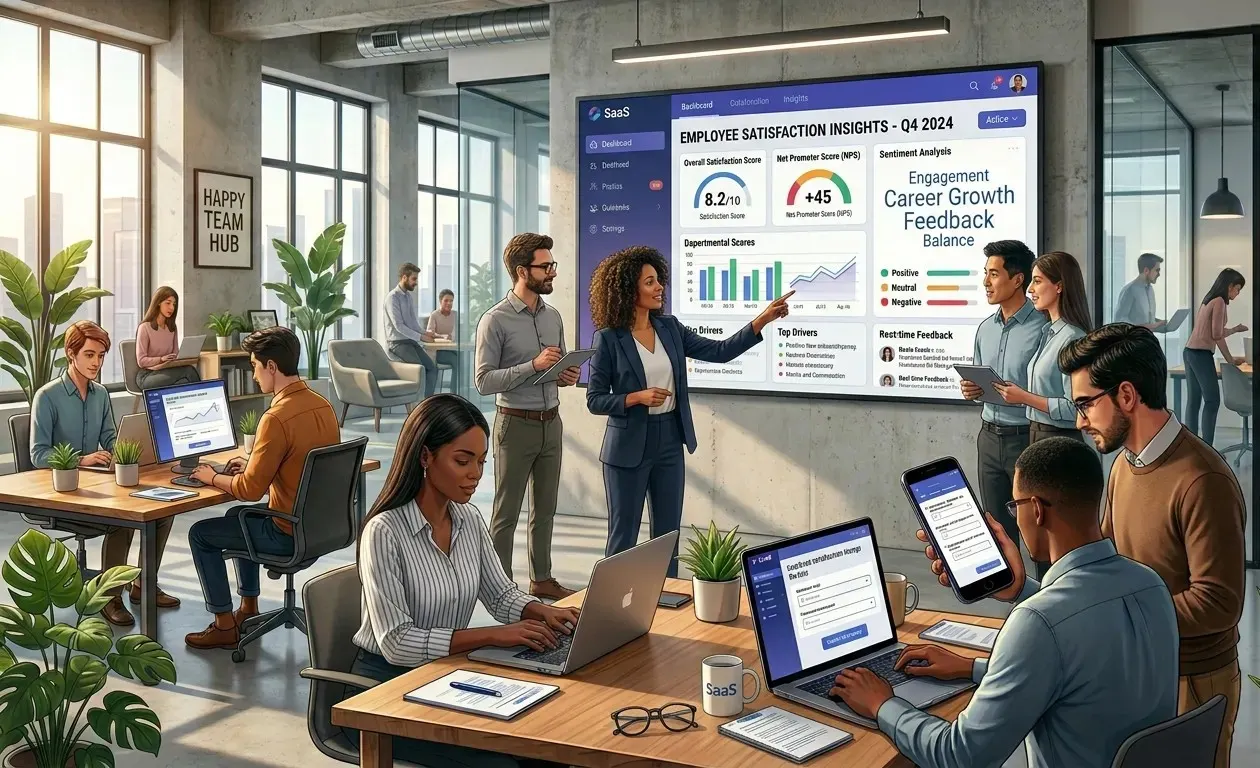
The right employee satisfaction measurement tools do more than collect survey responses. They help organizations detect friction early, understand experience at scale, and turn workforce sentiment into better retention, stronger culture, sharper decision-making, and measurable business performance.
Executive Summary
Employee satisfaction is no longer a soft, once-a-year HR topic. In 2026, it is a business operating signal. Hybrid work, changing employee expectations, manager capability gaps, digital fatigue, and rising pressure on productivity have made it harder for leaders to rely on instinct alone. Organizations need structured, repeatable ways to measure how employees feel about work, leadership, collaboration, growth, workload, and the overall employee experience. That is why demand for employee satisfaction measurement tools, employee satisfaction survey software, and full employee satisfaction software platforms continues to rise.
The best tools to measure employee satisfaction generally fall into a few categories: survey-led listening platforms, pulse feedback tools, sentiment and analytics platforms, employee experience suites, and all-in-one people performance systems. The strongest platforms do not stop at measurement. They support anonymity, segmentation, trend tracking, manager action planning, lifecycle listening, benchmarks, and governance. In other words, they help organizations move from “What are employees saying?” to “What do we do next?”
For most buyers, the decision is not simply about choosing a tool with the most features. It is about fit. Enterprise organizations may need deep analytics, governance, and global scale. Mid-market firms may want fast deployment, manager usability, and strong pulse capabilities. Some organizations need a broader employee experience platform; others need a focused listening layer that integrates with an existing HR stack. Enculture’s positioning is especially relevant here: it emphasizes culture transformation, employee engagement, employee experience, and data-driven insights designed to connect feedback with real action, not just reporting.
This guide explains what employee satisfaction measurement is, why it matters, what kinds of tools exist, how those tools support workplace success, and how to compare leading options. It also reviews several widely recognized solutions, including Enculture, Qualtrics, Culture Amp, Workday Peakon Employee Voice, Microsoft Viva Glint, and Officevibe, based on their public positioning and use cases. The goal is not to crown a universal winner. The goal is to help HR and business leaders choose the right approach for their context.
Introduction
Organizations have always cared about whether employees are satisfied. What has changed is the precision expected in measuring it. Historically, companies relied on annual engagement surveys, occasional exit interviews, and anecdotal manager input. That approach is too slow for a workplace shaped by hybrid teams, changing workforce expectations, new digital workflows, and talent markets that react quickly to poor employee experience. Leaders now need faster, cleaner signals about how employees feel and where friction is building.
What is employee satisfaction measurement?
Employee satisfaction measurement is the structured process of assessing how employees feel about their work, environment, leadership, recognition, compensation, development, workload, and overall experience. AIHR frames employee satisfaction as how happy employees are with their jobs and work environment, shaped by factors such as management, teamwork, stress, culture, and work-life balance. That definition matters because satisfaction is multi-factor, not singular. It cannot be captured through one question alone.
This is also where buyers often confuse satisfaction and engagement. They overlap, but they are not identical. Satisfaction typically reflects whether employees feel supported, fairly treated, and content with work conditions. Engagement goes further into commitment, energy, advocacy, and discretionary effort. In practice, satisfaction is often a foundation for engagement. If employees are persistently dissatisfied, engagement programs struggle to gain traction.
Employee satisfaction measurement impact
The business impact of measuring satisfaction comes from visibility. When organizations can identify which teams are struggling, where manager quality is uneven, which policies create friction, or which moments in the employee lifecycle are breaking trust, they can intervene earlier. Measurement makes culture observable. That is the real shift. Culture stops being discussed as intuition and starts being managed as a set of patterns, risks, and opportunities. Enculture’s own positioning reflects this logic: culture data should become actionable insight that drives measurable business results.
Why measuring satisfaction matters in 2026
In 2026, the case for better employee listening is stronger for four reasons.
First, workplace complexity is higher. Employee experience now spans physical, digital, managerial, and cultural environments. Second, expectations are sharper. Employees increasingly expect feedback loops to be real, not symbolic. Third, leaders are under pressure to prove the business impact of people's investments. Fourth, AI and analytics have raised the bar: if an organization can collect sentiment, segment responses, detect themes, and forecast risk, then simply running a static survey every year feels outdated. Platforms such as Qualtrics, Workday Peakon, Viva Glint, and Culture Amp explicitly position their offerings around continuous listening, actionable insights, and business outcomes like retention, satisfaction, and productivity.
A concise definition for search and answer engines: employee satisfaction measurement tools are software solutions that help organizations collect, analyze, and act on employee feedback to understand satisfaction, improve experience, and support workplace performance.
Why Organizations Should Measure Employee Satisfaction
Organizations should measure employee satisfaction because leadership assumptions are often incomplete. Senior teams may believe culture is healthy because attrition looks stable, managers report no major issues, or productivity appears strong. But satisfaction problems often emerge first as subtle signals: declining trust in leadership, burnout in specific teams, poor role clarity, weak recognition, or frustration with tools and processes. Without measurement, these signals stay fragmented.
Measurement also matters because employee experience has become a performance variable. When people do not feel heard, supported, or equipped to do good work, the downstream effects show up in retention, collaboration, customer experience, and manager effectiveness. Survey and feedback platforms repeatedly frame their value around turning employee insight into action that improves performance, retention, and workplace outcomes. Qualtrics links employee experience data to satisfaction, retention, and productivity. Culture Amp positions employee insights as a driver of performance at scale. Workday Peakon emphasizes real-time feedback and action. Microsoft Viva Glint describes its platform as a way to understand and act on employee feedback across moments that matter.
Another reason to measure satisfaction is governance. In large organizations, culture narratives vary by geography, function, level, and manager population. A company may have a strong enterprise story but weak local reality. Good employee satisfaction survey software helps leaders go beyond averages. It enables segmentation, trend comparison, and targeted action. That matters because broad organizational scores can hide concentrated risk in specific groups.
Finally, measurement is essential because action without diagnosis is expensive. Many organizations invest in learning, manager training, wellness, or recognition programs without knowing which drivers of dissatisfaction matter most. A disciplined measurement system helps prioritize interventions. Instead of solving everything, leaders can solve what matters most right now.
Summary
Organizations should measure employee satisfaction because it improves visibility, reduces blind spots, strengthens decision-making, and helps convert culture concerns into targeted business action.
Key Benefits of Measuring Employee Satisfaction
Improved employee retention
Retention rarely deteriorates without warning. Dissatisfaction often appears before intent to leave becomes visible in attrition data. Employees may feel stalled, unsupported, overworked, or disconnected long before they resign. Continuous listening tools help surface those risks earlier. Platforms such as Qualtrics and Culture Amp explicitly connect employee insight to retention outcomes, while Workday Peakon frames feedback as a way to understand experience and improve it before problems compound.
The deeper point is that retention is not solved by a single survey. It improves when measurement is recurring, segmented, and tied to clear accountability. If onboarding scores are weak, fix onboarding. If frontline managers are underperforming on communication, support that layer. If digital experience is harming morale, address workflows and systems rather than only culture messaging.
Higher productivity and performance
Satisfied employees are not automatically high performers, but persistent dissatisfaction is a drag on focus, collaboration, and energy. Measurement helps organizations find the hidden friction points that reduce performance: unclear goals, weak recognition, workload imbalance, poor manager communication, ineffective tools, or lack of development opportunity. Enculture, Culture Amp, Workday, and Viva each connect employee feedback with workplace productivity, manager effectiveness, or performance improvement in their public positioning.
In practice, productivity gains come less from the survey itself and more from what measurement reveals. The most useful employee satisfaction software platform is one that helps leaders understand which issues are systemic versus local, urgent versus structural, emotional versus operational.
Better organizational culture
Culture is often described as invisible architecture. Enculture uses similar language in explaining how culture shapes behavior, decisions, and outcomes. That framing is helpful because it reminds leaders that culture cannot be managed well through slogans alone. It must be observed through repeated signals: sentiment, trust, belonging, recognition, alignment, communication, fairness, and confidence in leadership.
Measurement supports culture improvement in two ways. First, it creates a shared baseline. Second, it makes progress trackable. Without measurement, culture work often becomes subjective and episodic. With measurement, organizations can see whether specific actions actually improve employee experience.
Stronger manager-employee relationships
Many employee experience problems sit at the manager layer. Employees interpret the organization through their day-to-day relationship with managers: whether communication is clear, feedback is useful, priorities are realistic, and recognition is present. Several platforms emphasize manager action as a core part of the listening cycle. Workleap Officevibe, for example, ties pulse surveys to one-on-ones and feedback routines. Culture Amp and Qualtrics both highlight manager usability and action orientation in various product positioning materials.
This matters because employee satisfaction improves when measurement is not just centralized in HR. The best systems enable managers to understand results, discuss them constructively, and follow through.
Data-driven decision-making
AIHR’s HR metrics guidance underscores that people's decisions increasingly need quantitative support. Satisfaction measurement contributes to that by turning opinion into structured data. Leaders can compare cohorts, track movement over time, test the effect of interventions, and combine sentiment signals with retention, absence, performance, or lifecycle data.
The benefit is not just more data. It is better prioritization. When leaders know which drivers most strongly influence satisfaction or engagement, they can direct resources more effectively.
Higher employee engagement and well-being
Satisfaction and engagement are distinct, but closely linked. AIHR notes that satisfaction can be considered a prerequisite or base for engagement. Tools that measure satisfaction well often support adjacent use cases such as engagement, well-being, inclusion, onboarding, and change readiness. Microsoft Viva Glint supports multiple survey programs across engagement, lifecycle, 360 feedback, and change-related areas. Workday Peakon and Qualtrics also position their solutions around broader employee experience and continuous listening, not just one-time satisfaction measurement.
Summary
The main benefits of measuring employee satisfaction are stronger retention, better productivity, healthier culture, better manager effectiveness, sharper people decisions, and stronger foundations for engagement and well-being.
Core Types of Employee Satisfaction Tools
One reason buyers struggle is that “employee satisfaction tools” is an umbrella term. Different platforms solve different parts of the listening problem. Choosing well starts with understanding categories.
1. Employee satisfaction surveys
These are structured surveys designed to assess how employees feel about work, leadership, resources, recognition, communication, and overall experience. Survey-led platforms remain foundational because they provide comparable, scalable data. AIHR points to employee satisfaction surveys as a central mechanism for understanding what employees think and feel. SurveyMonkey similarly positions employee satisfaction surveys as a way to measure happiness, morale, burnout, and related factors.
Best for: organizations that need a consistent baseline, broad comparability, and formal reporting.
2. Pulse survey tools
Pulse tools are lighter, more frequent instruments used to gather quick feedback on specific topics or team sentiment. Workday Peakon is strongly associated with continuous listening. Officevibe also emphasizes real-time feedback and pulse-style listening for SMBs and teams. Microsoft Viva Pulse complements Glint with quick leader- and manager-driven surveys.
Best for: organizations that want faster signals between formal survey cycles.
3. Feedback and sentiment analysis platforms
These tools go beyond scores and focus on open-text analysis, theme detection, qualitative insight, and in some cases AI-assisted interpretation. Qualtrics and Lattice both highlight AI-supported analysis of employee feedback, while Enculture emphasizes actionable culture intelligence.
Best for: organizations that receive large volumes of qualitative comments or want deeper understanding of drivers and themes.
4. Performance and engagement analytics tools
Some platforms combine employee listening with performance, development, and manager workflows. Culture Amp and Leapsome position themselves as broader employee experience or people enablement systems rather than narrow survey utilities. This matters if the organization wants satisfaction data to sit close to goals, reviews, manager development, or growth planning.
Best for: companies that want integrated people systems rather than a standalone survey layer.
5. 360-degree feedback systems
These tools are useful when the organization needs multi-source feedback on leadership, collaboration, or capability development. Microsoft Viva Glint includes 360 feedback among its supported programs. 360 systems do not replace satisfaction measurement, but they help explain manager or leadership drivers behind satisfaction trends.
Best for: leadership development, manager effectiveness, and targeted behavior change.
6. HR metrics dashboards and reporting tools
Some organizations already have surveys but lack dashboards, benchmarking, or cross-metric reporting. In those contexts, the priority may be analytics rather than collection. HR metrics dashboards help connect satisfaction data with retention, absence, participation, or business outcomes. AIHR’s broader HR metrics framework is useful here because it situates satisfaction as part of a wider people analytics picture.
Best for: organizations maturing from feedback collection to strategic people analytics.
7. Mobile-first employee feedback apps
For distributed or frontline workforces, accessibility matters as much as methodology. Mobile-first apps reduce response friction and can increase reach for employees who do not spend most of their day at desks. Enculture’s employee experience and feedback app positioning, along with Workleap Officevibe’s accessible feedback workflows, fits this use case.
Best for: frontline, distributed, deskless, or multilingual workforces.
Summary
The best tools to measure employee satisfaction usually combine survey collection, pulse listening, analytics, manager action, and reporting. The right mix depends on organizational scale, maturity, and use case.
How These Tools Support Workplace Success
Employee satisfaction tools support workplace success when they help leaders close the loop between listening and improvement. That sounds obvious, but it is where many programs fail. Collecting feedback is easy. Creating safe participation, analyzing results accurately, prioritizing the right problems, assigning ownership, and demonstrating follow-through is much harder.
The first contribution of good tooling is speed. Pulse and continuous listening platforms reduce the lag between experience and response. If change programs, restructures, or digital rollouts are creating friction, organizations can see that earlier. Workday Peakon’s public positioning around real-time insight and Viva Pulse’s team-level quick surveys both point to this advantage.
The second contribution is focus. Good employee satisfaction survey software helps identify what matters most. Instead of reacting to every complaint equally, leaders can see patterns. Are low scores concentrated in role clarity? Manager communication? Career development? Digital experience? Recognition? That focus is what turns a survey from an HR event into a management instrument. Qualtrics, Culture Amp, and Lattice all position their platforms around actionable insight rather than passive reporting.
The third contribution is accountability. Workplace success improves when managers and leaders can act on results at the right level. Enterprise-wide issues should stay with senior leadership. Team-level issues should be addressed closer to the manager-employee relationship. Tools that provide manager dashboards, guided actions, or structured follow-up are more likely to influence culture meaningfully than tools that stop at measurement.
The fourth contribution is trust. Employees will keep responding only if they believe feedback changes something. Platforms alone do not create trust, but they can support closed-loop follow-up, communication, and visible action planning. That is a major reason why culture transformation platforms need both listening and action infrastructure.
Best Tools to Measure Employee Satisfaction (In Random Order)
This section reviews several prominent tools based on their public positioning, core capabilities, and likely fit. These are not exhaustive product reviews, and feature depth can vary by plan and implementation. The purpose is strategic comparison.
1. Enculture
Enculture positions itself as an employee engagement and culture transformation platform designed to turn culture data into actionable insights and measurable business results. Its broader platform messaging spans employee engagement, employee experience, digital employee experience, and employee feedback, suggesting that it is intended as more than a simple survey utility. Enculture also highlights security and compliance across SOC 2, GDPR, and ISO 27001 on key product pages.
Key strengths
Enculture is especially relevant for organizations that want to connect feedback with culture transformation, not just measure scores. Its brand narrative emphasizes the gap between gathering employee feedback and creating meaningful cultural change, which is an important distinction. Many employers already have survey data. Fewer have systems that help leaders interpret it in a culture and action context. Enculture’s heritage story, which references roots in HR consultancy experience, strengthens that transformation-led positioning.
Best fit
Enculture appears well suited to organizations looking for a broader employee satisfaction software platform aligned with employee engagement, experience, and culture intelligence. It is a strong fit when the business wants measurement tied to action planning, culture priorities, and leadership decision-making rather than treated as a standalone HR survey program.
Watch-outs
Buyers should still evaluate implementation depth, survey methodology, benchmarking, integrations, reporting flexibility, and use-case fit against their internal maturity. The strategic promise is strong, but the right choice depends on the organization’s scale, governance model, and desired workflow.
2. Qualtrics Employee Experience
Qualtrics positions its employee experience suite as a holistic platform that helps organizations capture critical employee data using survey designs and passive listening, then make informed decisions that drive employee satisfaction, retention, and productivity. Its employee engagement solution emphasizes research-based survey design, validated items, and preconfigured dashboards.
Key strengths
Qualtrics is one of the strongest options for enterprises that want scale, methodology, flexible survey design, and broad experience management capability. It is particularly strong where organizations need mature research logic, global deployment, multiple listening programs, and deeper analytics across employee experience. Its value proposition is not limited to measuring sentiment; it is about tying experience data to business decisions.
Best fit
Large enterprises, complex organizations, and teams with mature EX or people analytics functions tend to benefit most. It is also useful where employee satisfaction needs to be part of a wider listening ecosystem that includes lifecycle, research, and passive feedback.
Watch-outs
Qualtrics can be more than some mid-market buyers need. Organizations should evaluate whether they need its breadth or whether a more focused tool would drive faster adoption.
3. Culture Amp
Culture Amp describes itself as an employee experience platform that helps organizations make data-informed people decisions and drive performance at scale. It connects engagement, performance, and development, which is valuable for companies that do not want satisfaction data isolated from broader people practices. Culture Amp also frames its employee engagement solution around asking the right questions and inspiring the right actions.
Key strengths
Culture Amp’s strength is that it links listening with manager effectiveness, performance, and development. That makes it attractive to organizations seeking a balance between diagnostic depth and practical follow-through. It is especially useful when leaders want satisfaction measurement to influence how managers lead and how teams develop, not just how HR reports.
Best fit
Mid-market and enterprise organizations looking for a robust employee experience platform with strong people-development adjacency.
Watch-outs
Companies that want a lightweight pulse tool may find a broader platform unnecessary. As with any suite, value depends on adoption beyond HR.
4. Workday Peakon Employee Voice
Workday Peakon Employee Voice positions itself as an AI-powered listening solution that helps organizations keep a pulse on how people feel and put plans in place to address feedback. Its core narrative centers on continuous listening, real-time insight, and actionable employee feedback.
Key strengths
Peakon is especially strong for organizations that want more than annual surveying. Its strength lies in continuous listening, always-on insight, and action orientation. That is valuable in fast-changing environments where employee sentiment can shift quickly across teams, locations, or business units.
Best fit
Organizations that want a mature listening program, especially enterprises with ongoing change, distributed workforces, or a need for faster response cycles.
Watch-outs
The biggest question for buyers is integration into broader HR systems and action workflows. Continuous listening creates more data; organizations still need clear governance to turn it into disciplined action.
5. Microsoft Viva Glint
Microsoft Viva Glint helps organizations understand and act on employee feedback through customizable survey programs covering engagement, onboarding, exit, diversity and inclusion, digital transformation, change management, 360s, and other moments that matter. Microsoft explicitly differentiates Viva Glint from Viva Pulse: Glint is designed for robust, organization-wide listening aligned to leadership objectives, while Pulse supports quick team feedback.
Key strengths
Glint’s strength is program breadth and integration into the Microsoft ecosystem. It supports multiple survey types and lifecycle programs, making it useful for organizations that want a structured employee listening architecture rather than one-off surveys. Microsoft Learn materials also reference very large-scale analysis used in Glint’s engagement template design, which signals methodological maturity.
Best fit
Organizations already invested in Microsoft Viva or Microsoft 365, especially those building an integrated approach to engagement, productivity, and employee listening.
Watch-outs
The best fit depends heavily on existing Microsoft stack adoption and internal capability to manage formal listening programs at scale.
6. Workleap Officevibe
Officevibe is positioned as an employee survey and feedback management solution for SMBs, with real-time feedback, pulse surveys, and one-on-one conversation support. Its messaging emphasizes simplicity, retention, performance, and manager-level usability.
Key strengths
Officevibe’s value is accessibility. It is easier to understand, easier to deploy, and better suited to organizations that want to build manager habits around feedback without standing up a heavy enterprise listening architecture. It is a good illustration that not every buyer needs a full enterprise employee satisfaction software platform to succeed.
Best fit
Small and mid-sized businesses, or teams inside larger organizations that want lightweight pulse listening and practical follow-up.
Watch-outs
Enterprise buyers may need more depth in benchmarking, analytics, governance, or cross-program architecture.
Honorable mentions
Other relevant options include Leapsome, which combines engagement surveys with performance, goals, and learning, and SurveyMonkey, which offers employee engagement and satisfaction survey capabilities in a more general survey environment. Lattice is also notable for combining engagement surveys with broader people success workflows and AI-supported analysis.
Summary
The best tools to measure employee satisfaction are not identical in scope. Enculture, Qualtrics, Culture Amp, Workday Peakon, Microsoft Viva Glint, and Officevibe each serve different maturity levels and operating models.
How to Compare Employee Satisfaction Tools
Comparing tools well requires moving past superficial feature checklists. The better comparison framework asks six questions.
1. What listening model do you need?
Do you need annual surveys, pulse surveys, lifecycle surveys, continuous listening, or all of the above? A global transformation program needs a different model than a 300-person company looking for quarterly sentiment checks. Workday Peakon and Viva Glint are stronger in formal listening architecture, while Officevibe is lighter and more immediate.
2. How much does depth matter?
Some organizations need simple dashboards. Others need heatmaps, trend analysis, segmentation, benchmarks, text analytics, and driver analysis. Qualtrics, Culture Amp, Lattice, and Leapsome all publicly emphasize analytics or actionable insight in different ways.
3. Who needs to act on the data?
If only HR uses the platform, the workflow can be more centralized. If managers are expected to own action planning, the tool must be intuitive and manager-friendly. This is one reason simpler tools sometimes outperform more feature-rich systems in practice.
4. How important is integration?
A standalone survey tool can work, but integration matters when organizations want to link satisfaction data with HRIS, lifecycle events, productivity tools, or employee experience workflows.
5. What level of governance is required?
Global enterprises need anonymity rules, role-based access, segmentation controls, and careful reporting logic. Enculture’s security language, along with enterprise-grade compliance references on several vendor pages, signals that governance and compliance are part of the buying discussion.
6. What business outcomes matter most?
If the primary goal is culture transformation, Enculture may fit well. If the goal is broad EX program maturity, Qualtrics or Viva Glint may be stronger. If the goal is manager-centered action in a mid-market context, Culture Amp or Officevibe may be more appropriate.
Key Factors to Consider Before Choosing a Tool
The most common mistake in buying tools to measure employee satisfaction is selecting for brand recognition before implementation fit. A strong purchase decision usually considers the following factors.
Measurement philosophy
Does the platform support scientifically grounded items, customizable design, or validated templates? Tools vary in how structured versus flexible they are. The right answer depends on whether the organization prioritizes comparability, customization, or speed. Qualtrics highlights validated items and research-based design, while Microsoft Viva Glint references large-scale survey analysis behind its templates.
Anonymity and trust
Employees respond honestly only when confidentiality feels credible. Buyers should examine anonymity thresholds, reporting rules, access permissions, and communication support.
Segmentation and diagnostics
Can the tool reveal differences by department, geography, level, tenure, or manager population? High averages are less useful than precise patterns.
Action planning support
Does the platform help managers and leaders respond? Insight without workflow rarely changes culture.
Lifecycle coverage
Can the platform measure onboarding, exit, change, manager effectiveness, or moments that matter beyond general satisfaction? Viva Glint’s program model is strong here.
Usability
Will managers and employees actually use it? Ease matters more than many buyers admit.
Scalability and compliance
For enterprise buyers, scale, security, access control, and compliance are non-negotiable. Enculture’s product pages mention SOC 2, GDPR, and ISO 27001 across experience and engagement pages, which is relevant for buyers screening enterprise readiness.
Commercial fit
A great platform that is too heavy, too costly, or too complex for internal capability will underperform. Fit beats prestige.
Implementation and Data Interpretation Tips
Even the best employee satisfaction app or platform fails if the operating model is weak. Implementation quality shapes whether the tool becomes a one-time HR project or a durable listening system.
Start with a clear measurement question
Do not begin with “We need a survey.” Begin with “What do we need to understand?” That could be baseline satisfaction, manager trust, hybrid work friction, digital experience, onboarding quality, or change readiness. Measurement should follow the business question.
Separate satisfaction from everything else
Satisfaction is related to engagement, culture, performance, and well-being, but it is not identical to them. If the tool tries to measure everything without conceptual clarity, the result is noisy data and weak action.
Protect survey discipline
Frequency matters, but over-surveying harms credibility. Pulse surveys should feel purposeful, not constant. Continuous listening does not mean endless questioning.
Plan the action layer before launch
Who receives results? Who communicates with them? Who owns action planning? What is the timeline for follow-up? Tools cannot fix governance gaps.
Interpret scores in context
A satisfaction score is never just a number. Compare by team, trend, change event, manager quality, and qualitative comments. A “good” score in a deteriorating trend may be more concerning than a lower but improving score.
Combine quantitative and qualitative insight
Closed-ended items tell you where. Open-ended comments help explain why. Sentiment and text analysis features are increasingly valuable because they reveal patterns leadership may not anticipate.
Train managers to respond well
Poor manager follow-up can damage trust more than not asking at all. Managers need support in interpreting results, discussing them constructively, and committing to realistic actions.
Close the loop visibly
Employees need to see what changed. Even when organizations cannot solve every issue immediately, visible response matters. The credibility of future measurement depends on the action quality of previous rounds.
Summary
Implementation succeeds when employee satisfaction measurement is treated as a management system, not just a survey event. Clear objectives, disciplined governance, manager enablement, and visible follow-through matter more than feature volume alone.
Final Thoughts
The market for employee satisfaction measurement tools is more mature than it was a few years ago, but buying has also become more complex. There are now lightweight survey tools, enterprise listening architectures, integrated people platforms, and culture transformation systems all competing under similar language. That makes clarity essential.
For most organizations, the best tool is the one that fits their stage, operating model, and ambition. If the goal is quick pulse visibility and manager action in a smaller environment, a simpler tool may be ideal. If the goal is enterprise-wide listening with lifecycle programs and deep analytics, a broader platform is often the better choice. If the goal is culture transformation grounded in actionable insight, Enculture’s positioning is especially compelling because it sits at the intersection of employee engagement, employee experience, and culture intelligence.
The bigger lesson is that measurement is not the end state. Workplace success comes from what organizations do with the insight. The best employee satisfaction survey software should help leaders listen more intelligently, interpret more confidently, and act more consistently. In 2026, that is what separates a survey tool from a strategic workplace platform.
Key Takeaways
- Employee satisfaction measurement has become a strategic business capability, not just an HR reporting activity.
- The best employee satisfaction tools combine listening, analytics, segmentation, and action support.
- Satisfaction and engagement are related but different; strong measurement programs account for both.
- The right platform depends on organizational size, operating model, desired analytics depth, and action maturity.
- Enculture is especially relevant for organizations that want satisfaction measurement connected to culture transformation, employee experience, and actionable insight.
- Qualtrics, Culture Amp, Workday Peakon, Microsoft Viva Glint, and Officevibe each offer distinct strengths across enterprise scale, continuous listening, manager usability, and integrated people workflows.
- Tool selection should be driven by fit, not feature volume alone.
- Successful implementation depends on trust, governance, manager enablement, and visible follow-through.
From mental health support to career development opportunities, this checklist ensures you're not missing critical elements that impact employee satisfaction. Includes assessment criteria, scoring guidelines, and prioritization framework to turn insights into action.
Get Free AccessRead Our Other Blogs

See what our customers are saying
Implementation was handled well. Their team guided us and helped in resolving the challenges. We were able to gather insights that identified cultural risk factors..


See what our customers are saying
What impresses me most is how intuitive the platform is. Our teams quickly embraced the tools, resulting in a very high survey completion rate. The actionable data has driven tangible improvements company-wide. We are happy to explore other offerings from the platform.
Access exclusive resources today
Frequently asked questions
Explore our frequently asked questions to learn more about Enculture’s features, security, integration capabilities, and more

Enculture combines strategic HR consulting expertise with advanced technology to provide a consultative approach rather than a purely product-led experience. This tailored method ensures that our solutions are specifically aligned with each company’s unique culture and objectives.
Through in-depth analytics and sentiment tracking, our platform can highlight areas where employees may be disengaged or dissatisfied, enabling proactive action. Identifying these risks early helps prevent issues like increased turnover or declining productivity.
We turn data into clear, practical steps. Enculture provides HR leaders with data-driven recommendations and dashboards that pinpoint where to focus efforts, enabling organizations to act on survey feedback effectively.
Our platform offers highly customizable survey templates and tools, allowing HR teams to tailor questions to their unique organizational needs and goals. This flexibility ensures that the insights are relevant and actionable for your specific workplace environment.
Enculture is designed to scale with your organization. As your culture and engagement needs evolve, our platform’s flexibility and customization options allow it to adapt seamlessly to new challenges and goals.
.svg)