.svg)

50+ Greatest Benefits of Employee Engagement Surveys | 2026 Edition
.svg)
.svg)
Download our comprehensive framework with 50+ assessment criteria, scoring methodology, and action planning worksheets.
Download E-bookTop 50+ Benefits of Employee Engagement Surveys for Organisations in 2026
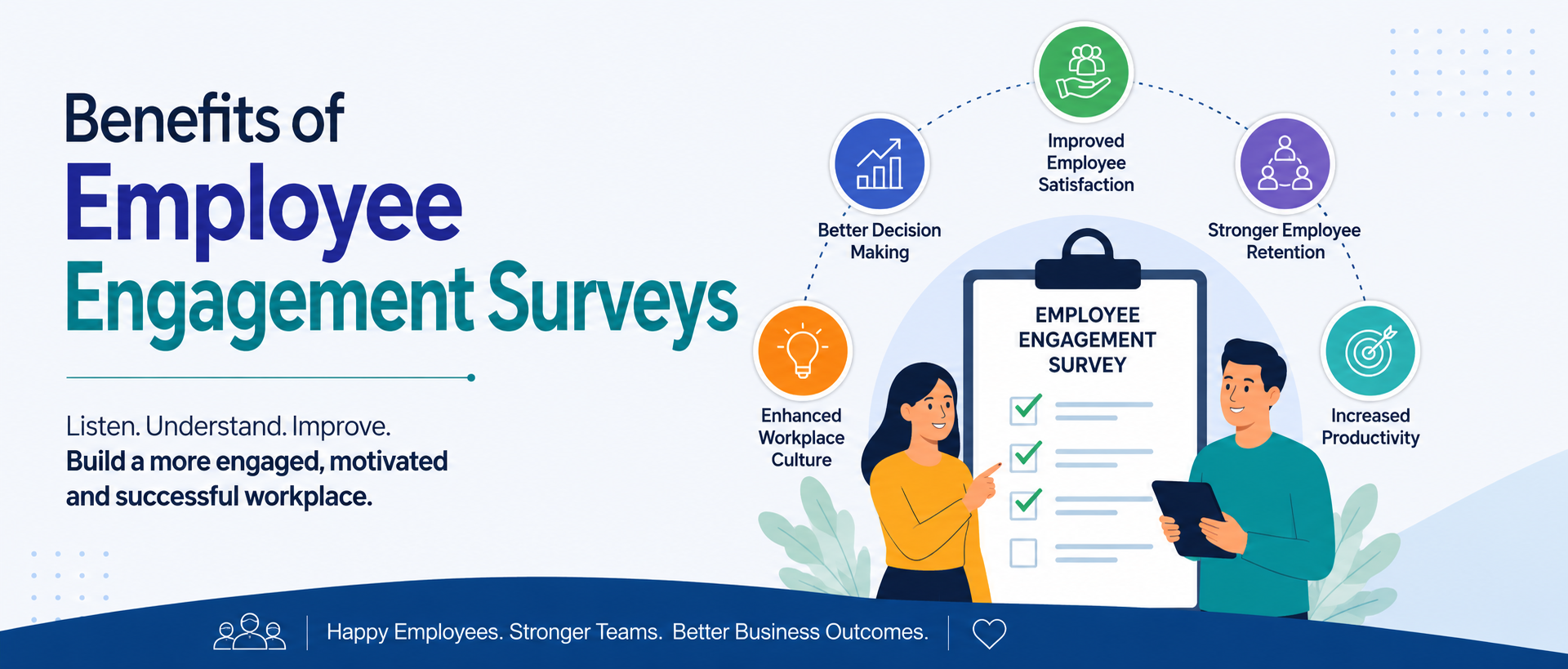
Employee engagement surveys help organisations understand what employees need, what is blocking performance, where culture is strong, and where leadership must act. The benefits of employee engagement survey programmes go far beyond morale tracking: they improve retention, manager effectiveness, productivity, trust, recognition, wellbeing, DEI, and business decision-making.
For HR leaders, CHROs, CEOs, and managers in 2026, the real employee engagement survey purpose is not to “collect feedback”. It is to convert employee voice into better decisions, stronger teams, and measurable organisational outcomes.
This matters even more now because work has changed. AI is reshaping roles, hybrid teams are more common, employees expect sharper communication, and leadership trust is harder to earn. Gartner’s 2026 HR priorities highlight the need for HR leaders to align people strategy with future business needs, while McKinsey’s research connects employee experience with broader organisational health and long-term performance.
In India, the urgency is especially real. Employees are navigating rapid digital change, rising career expectations, distributed teams, pay pressure, wellbeing concerns, and global working models. A strong survey strategy gives leaders an early-warning system before disengagement becomes attrition.
What Is an Employee Feedback Tool?
An employee feedback tool is a digital platform that helps organisations collect, analyse, and act on employee input across the employee lifecycle. It may include engagement surveys, pulse surveys, anonymous feedback, eNPS, lifecycle surveys, manager feedback, recognition signals, sentiment analytics, and action-planning workflows.
A useful definition is:
An employee feedback tool is a structured listening system that converts employee voice into measurable insights leaders can use to improve culture, engagement, retention, and performance.
The best tools do not simply ask questions. They help leaders understand patterns: where employees feel energised, where teams are losing trust, where managers need support, where workloads are unsustainable, and where culture is becoming inconsistent across locations or business units.
For a company in India with teams across Bengaluru, Mumbai, Delhi NCR, Hyderabad, Chennai, Singapore, Dubai, London, and the US, this matters because the employee experience is not uniform. A sales team in Mumbai may experience pressure differently from a product team in Bengaluru. A remote employee working with US time zones may face burnout patterns that do not appear in office attendance data. An employee in a fast-growth business unit may feel energised by opportunity but unclear about career progression.
Feedback tools make these differences visible.
The important point: a feedback tool is not the same as a survey form. A form collects responses. A good tool creates a listening discipline. It helps HRBPs, managers, and leadership teams understand what to do next.
What Is the Purpose of Employee Engagement Surveys?
The purpose of employee engagement surveys is to measure the conditions that influence employee commitment, motivation, performance, and intent to stay. A strong engagement survey helps answer five executive questions:
- Are employees emotionally connected to the organisation’s goals?
- Do managers create clarity, trust, recognition, and accountability?
- Are employees able to do meaningful work without unnecessary friction?
- Which teams or locations face higher retention risk?
- What actions will improve culture and performance fastest?
Gallup defines employee engagement as the involvement and enthusiasm employees have in their work and workplace. Gallup also notes that engagement improves when employees feel connected to their work, valued for their strengths, and supported by strong managers.
That is the real value of employee engagement surveys: they help leaders move from assumption to evidence.
Without employee listening, leadership often relies on selective anecdotes. The loudest voices dominate. High performers may quietly disengage. Managers may under-report issues. HR may only see the problem once resignation letters, exit interviews, poor Glassdoor reviews, or productivity drops appear.
A well-designed engagement survey helps organisations detect culture risk early.
Engagement vs Satisfaction, Culture vs Climate, Measurement vs Transformation
Many organisations struggle because they use workplace terms interchangeably. A high-quality survey strategy starts with clarity.
Engagement vs Satisfaction
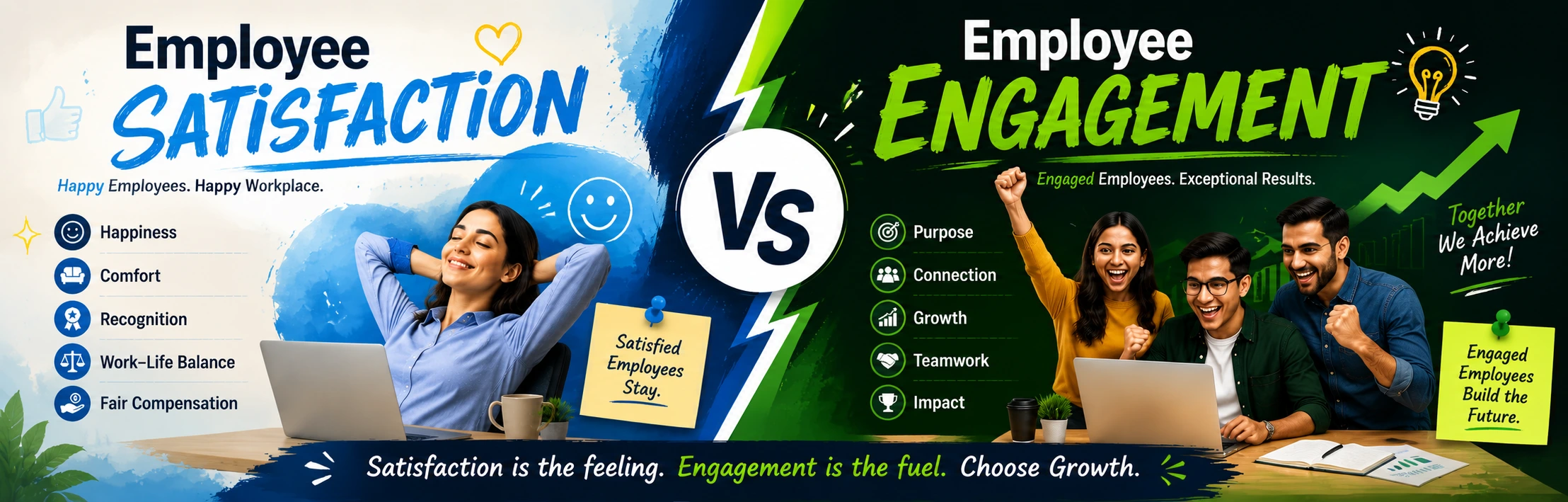
Employee satisfaction asks: “Are employees content with aspects of their job?”
Employee engagement asks: “Are employees committed, motivated, and willing to contribute discretionary effort?”
An employee may be satisfied with salary, flexibility, and colleagues but still not feel inspired, challenged, recognised, or aligned with the company’s mission. Satisfaction is useful, but engagement is more predictive of energy, performance, advocacy, and retention.
For example, a software engineer may be satisfied with hybrid work but disengaged because roadmap priorities keep changing. A teacher may like the school community but feel disengaged if recognition is inconsistent. A sales manager may be satisfied with incentives but disengaged if leadership communication is unclear.
This is why the employee engagement survey importance lies in measuring the drivers behind performance, not just happiness.
Culture vs Climate
Culture is the deeper system of shared values, behaviours, rituals, leadership norms, and decision-making patterns.
Climate is how employees experience the organisation right now.
Culture answers: “How do things really work here?”
Climate answers: “How does it feel to work here today?”
A survey can measure both, but leaders should not confuse them. A pulse survey may reveal a temporary climate issue after a restructuring. A culture health check may reveal a deeper pattern, such as low psychological safety, weak accountability, or inconsistent recognition.
Measurement vs Transformation
Measurement tells you what is happening.
Transformation changes what is happening.
This distinction matters because many companies run engagement surveys every year and still see limited improvement. The reason is simple: measurement without follow-through creates survey fatigue. Employees do not disengage because they were asked for feedback. They disengage when they were asked, answered honestly, and saw nothing change.
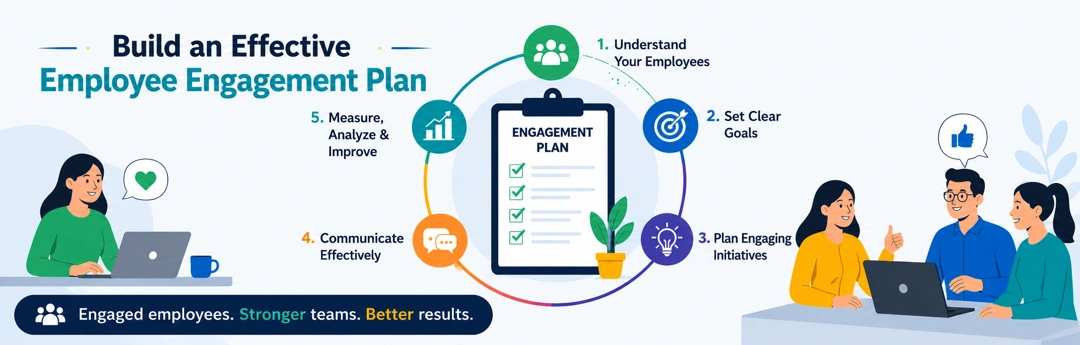
The strongest organisations treat surveys as part of a transformation loop: listen, diagnose, prioritise, act, communicate, measure again.
Why Feedback Tools Are Critical in 2026
Feedback tools are critical in 2026 because the workplace is becoming more complex, less visible, and more emotionally demanding.
Several forces are converging:
AI is changing job roles, workflows, and skill expectations. Microsoft’s Work Trend Index continues to track how AI and work redesign are reshaping knowledge work globally.
Hybrid and distributed work have made informal culture harder to observe. Leaders can no longer rely on office energy, corridor conversations, or occasional town halls to understand sentiment.
Employees expect more transparency from leadership. They want to know how decisions are made, how performance is evaluated, what career growth looks like, and how AI will affect their roles.
Manager quality has become a major engagement lever. Gallup’s engagement content consistently emphasises the role of managers in creating clarity, recognition, and connection.
In India, fast-scaling companies face additional complexity: high talent mobility, multi-generational workforces, regional diversity, global client demands, and rising employee expectations around wellbeing and career growth. Recent Indian workplace coverage has also highlighted concerns around compensation satisfaction, mental wellness, Gen Z expectations, and work-life boundaries.
For HR leaders, the implication is clear: annual intuition is not enough. Organisations need continuous employee listening, culture analytics, and engagement diagnostics that can separate isolated complaints from systemic risk.
Why Organisations Need Employee Feedback Tools
Organisations need employee feedback tools because culture is now too important to manage casually.
A CEO may believe communication is clear. Employees may experience it as fragmented.
A CHRO may believe career paths are well-defined. Employees may experience them as opaque.
A manager may believe the team is doing fine. Employees may be exhausted but silent.
A leadership team may believe hybrid work is working. Employees across time zones may feel disconnected, over-meetinged, and invisible.
Employee feedback tools make these hidden gaps measurable.
They also help leaders see variation. Engagement is rarely uniform across the company. One function may be thriving while another is struggling. One manager may create high psychological safety while another creates avoidable churn. One location may feel included in global decisions while another feels like an execution centre.
For global teams across India, SEA, MENA, the UK, and the US, this nuance is essential. Cultural expectations differ. Employees in India may place strong value on career progression, manager support, and learning opportunities. Teams in the UK may be more vocal about work-life boundaries. MENA teams may place importance on belonging, stability, and leadership respect. SEA teams may value harmony, clarity, and growth. US teams may expect faster feedback loops and autonomy.
A one-size-fits-all engagement strategy misses these differences. A thoughtful listening platform helps leaders localise action while maintaining global culture consistency.
Top 50+ Benefits of Employee Engagement Surveys for Organisations
The benefits of employee engagement survey programmes become most powerful when surveys are treated as decision systems, not HR rituals. Below are 50+ practical benefits for organisations in 2026.
1. They create a direct employee voice channel
Engagement surveys give employees a structured way to express what is working, what is not working, and what they need from leadership. This is especially valuable in large or distributed organisations where senior leaders cannot personally hear every team’s experience.
The benefit is not only feedback collection. It is signal creation. Employees who may not speak in open forums can share input through confidential or anonymous formats.
2. They strengthen two-way communication
A survey is not a one-way broadcast. When done well, it becomes a two-way communication loop: leadership asks, employees respond, leaders act, and employees see progress.
This strengthens trust because it shows that communication is not limited to town halls, leadership emails, or performance reviews. It creates a regular channel for listening.
3. They reveal real-time sentiment
Pulse surveys and always-on feedback tools help leaders understand how employees feel during change, not months later. This is important during restructuring, policy shifts, mergers, leadership transitions, AI rollouts, or return-to-office decisions.
A quarterly or monthly pulse can show whether confidence is improving or deteriorating.
4. They improve employee retention
Engagement surveys help identify drivers of attrition before employees resign. Warning signs may include low career clarity, weak manager relationships, poor recognition, limited growth, overload, or low trust in leadership.
Retention improves when organisations act on these signals early.
5. They reduce regrettable attrition
Not all attrition is equally damaging. The bigger risk is losing high performers, future leaders, critical-skill talent, or culture carriers.
Engagement diagnostics can help HRBPs identify where these populations feel unsupported or under-recognised.
6. They improve manager effectiveness
Managers are often the strongest local driver of engagement. Surveys can show whether managers provide clarity, feedback, recognition, psychological safety, and support.
This helps organisations move manager development from generic training to targeted coaching.
7. They support continuous performance improvement
Employee engagement affects performance because people do better work when they understand priorities, trust leadership, feel recognised, and have the tools they need.
Surveys reveal friction points that slow performance: unclear goals, poor collaboration, weak decision-making, excessive meetings, or lack of autonomy.
8. They help leaders make data-driven people decisions
The value of employee engagement surveys lies in better decision-making. Instead of relying on instincts, HR and business leaders can use engagement data to decide where to invest, which teams need support, and which culture risks require leadership attention.
9. They improve recognition culture
Recognition is a powerful engagement driver. Surveys can reveal whether employees feel appreciated, whether recognition is fair, and whether managers notice good work.
This helps companies shift recognition from occasional awards to everyday behaviour.
10. They build manager-employee alignment
Engagement surveys reveal whether employees understand goals, priorities, role expectations, and how their work connects to business outcomes.
When alignment is low, performance suffers. When alignment is high, teams move faster with less confusion.
11. They support leadership credibility
Employees judge leaders by consistency between words and actions. Surveys help leaders understand whether their messages are landing, whether trust is improving, and whether employees believe leadership decisions are fair.
12. They improve culture analytics
Culture analytics help organisations measure the behaviours and norms that shape performance. Surveys can track trust, psychological safety, inclusion, accountability, collaboration, recognition, and learning orientation.
13. They enable culture health checks
A culture health check helps leaders understand whether the organisation’s stated values match employee reality. This is especially useful after rapid hiring, acquisitions, leadership changes, or geographic expansion.
14. They identify burnout risk
Burnout is not always visible. Employees may continue delivering work while quietly losing energy and motivation.
Surveys can identify workload pressure, lack of recovery time, always-on communication, low control, and emotional exhaustion.
15. They improve wellbeing strategy
Wellbeing programmes often fail when they focus only on benefits and ignore root causes. Engagement surveys help leaders understand whether wellbeing issues are caused by workload, manager behaviour, role ambiguity, lack of flexibility, or poor team norms.
16. They support DEI and belonging
Surveys can reveal whether employees from different groups experience fairness, inclusion, respect, growth opportunities, and psychological safety differently.
This helps organisations move beyond DEI statements to measurable inclusion.
17. They strengthen psychological safety
Employees need to feel safe raising concerns, asking questions, admitting mistakes, and challenging ideas. Surveys can measure whether psychological safety differs by team, manager, level, or location.
18. They improve change management
During change, employees need clarity, empathy, and involvement. Surveys can show whether people understand the reason for change, trust the process, and feel equipped to adapt.
19. They reduce leadership blind spots
Senior leaders often see lagging indicators: attrition, productivity dips, grievance escalation, or missed targets. Engagement surveys provide earlier signals.
20. They improve HRBP effectiveness
HRBPs can use survey insights to have sharper conversations with business leaders. Instead of saying “morale seems low”, they can say “career clarity is 18 points lower in this function than the company average, and open comments show confusion around promotion criteria.”
21. They help prioritise action
Not every issue needs equal attention. Survey analytics can show which drivers have the strongest relationship with engagement, retention, performance, or trust.
This prevents HR teams from spreading effort too thin.
22. They make employee listening scalable
As organisations grow, informal listening becomes inconsistent. A survey platform creates repeatable listening across teams, locations, and levels.
23. They help distributed teams feel heard
Remote and hybrid employees can feel invisible. Surveys give them a voice and help leaders compare office-based, hybrid, and remote experiences.
24. They improve hybrid work decisions
Hybrid policies often fail when they are based on ideology rather than evidence. Surveys can show how different work models affect collaboration, focus, belonging, productivity, and wellbeing.
25. They surface time-zone friction
Global teams often struggle with meeting overload, late-night calls, and asynchronous communication gaps. Surveys can reveal which teams are carrying the hidden cost of global collaboration.
26. They improve onboarding
New-hire pulse surveys can show whether employees understand their role, feel welcomed, have manager support, and know how to succeed.
This reduces early attrition.
27. They improve internal mobility
Surveys can identify whether employees see growth opportunities inside the organisation. Low scores may indicate unclear career paths, manager gatekeeping, or weak talent marketplace visibility.
28. They improve learning and development strategy
Engagement data can reveal skill gaps, learning needs, confidence levels, and whether employees feel prepared for future roles.
This is especially important as AI changes work.
29. They support workforce planning
Engagement insights can help leaders understand which teams are stretched, which roles are at risk, and where capability investment is needed.
30. They improve productivity by removing friction
Disengagement is not always emotional. Sometimes it is operational. Employees may be blocked by slow approvals, unclear ownership, poor systems, or too many meetings.
Surveys help identify friction that productivity dashboards may miss.
31. They strengthen accountability
When survey results are shared with managers and leaders, culture becomes a leadership responsibility, not just an HR initiative.
32. They improve employee trust
Trust improves when employees see that feedback leads to action. Even when leaders cannot solve every issue immediately, transparent communication builds credibility.
33. They reduce survey fatigue when designed well
This may sound counterintuitive. Poor surveys create fatigue. Good surveys reduce fatigue by asking fewer, sharper questions and closing the loop.
Employees are more willing to respond when they see action.
34. They help detect toxic team dynamics
Survey comments and team-level patterns can reveal issues such as fear, exclusion, favouritism, disrespect, or poor conflict management.
Early detection matters because toxic behaviours can spread.
35. They improve employer brand
Employees who feel heard are more likely to advocate for the organisation. Over time, stronger culture improves referrals, candidate perception, and retention.
36. They support leadership development
Survey data can show which leadership behaviours need improvement: communication, empathy, decision-making, recognition, coaching, or fairness.
37. They improve performance management
Engagement surveys can reveal whether performance expectations are clear, feedback is useful, and performance conversations feel fair.
38. They improve recognition equity
Some teams receive frequent recognition. Others quietly deliver without visibility. Surveys help reveal recognition gaps by function, location, level, gender, tenure, or work mode.
39. They help leaders understand generational expectations
Gen Z, millennials, Gen X, and senior professionals may value different aspects of work. Surveys help organisations avoid stereotypes and understand real patterns.
40. They support culture integration after mergers
After acquisitions or restructuring, surveys can show whether employees feel included, informed, and aligned with the new organisation.
41. They help measure culture transformation
Culture transformation cannot be judged by posters, values campaigns, or leadership workshops alone. Surveys track whether behaviours are changing.
42. They improve decision-making speed
When leaders have reliable people data, they can act faster. They do not need to wait for escalation.
43. They strengthen fairness perceptions
Employees care deeply about fairness in pay, promotions, workload, recognition, and leadership access. Surveys help identify where fairness is questioned.
44. They improve internal communication
Surveys can reveal whether employees understand business strategy, leadership priorities, and policy changes.
45. They support agile HR
Instead of annual HR planning based only on historical data, engagement surveys help HR teams respond continuously.
46. They improve customer experience indirectly
Employee experience often influences customer experience. Engaged employees are more likely to solve problems, collaborate, and represent the brand positively.
47. They help identify high-performing culture pockets
Surveys are not only for finding problems. They also reveal teams with strong cultures. Leaders can study what these teams do differently and scale those practices.
48. They improve board-level people reporting
Boards increasingly expect stronger people to risk visibility. Engagement data can support reporting on retention risk, culture health, leadership trust, DEI, and workforce resilience.
49. They make culture measurable without oversimplifying it
Culture is complex, but it is not immeasurable. The right survey design helps quantify meaningful patterns while preserving qualitative nuance through comments.
50. They help organisations move from reactive HR to proactive culture intelligence
Culture intelligence means understanding the health, drivers, and risks of organisational culture in a structured way. Engagement surveys are one of the foundations of this capability.
51. They connect people data to business outcomes
The most mature organisations connect engagement insights with attrition, performance, productivity, absenteeism, customer satisfaction, safety, innovation, or revenue metrics.
52. They improve manager conversations
Survey results give managers a starting point for team discussions. Instead of guessing what the team needs, managers can discuss specific themes.
53. They help employees feel respected
Asking for feedback signals respect. Acting on feedback proves it.
54. They create a habit of listening
Culture improves when listening becomes routine, not exceptional. The strongest organisations build listening into the rhythm of work.
55. They help leaders focus on what matters most
Ultimately, engagement surveys help organisations separate noise from priority signals. They show what matters most to employees and what matters most for performance.
What Most Teams Get Wrong About Engagement Surveys
Many organisations run engagement surveys with good intent but poor design. The common mistakes are predictable.
First, they ask too many questions. Long surveys reduce completion rates and create unclear outputs. Employees do not want to answer 80 questions if leaders only act on three themes.
Second, they confuse measurement with action. Survey reports are not outcomes. Dashboards are not culture change.
Third, they over-focus on scores. A score of 72 means little unless leaders understand what is driving it, where it differs, and what action will improve it.
Fourth, they treat all comments equally. One emotional comment may be important, but leaders need to understand whether it represents a pattern or an isolated experience.
Fifth, they push results to managers without enabling them. Managers need guidance, talking points, team discussion templates, and realistic action-planning support.
Sixth, they fail to communicate back. Employees should know what was heard, what will change, what will not change, and why.
Seventh, they run surveys too rarely. Annual surveys are useful for deep diagnosis, but they are too slow for fast-changing teams.
The practical guidance is simple: ask fewer, better questions; diagnose root causes; communicate transparently; and build action into the process before launching the survey.
Signal vs Noise: How to Read Engagement Data Properly
Not every data point deserves equal attention. A mature engagement survey programme distinguishes signal from noise.
A signal is a pattern that is consistent, material, and actionable.
Noise is isolated, emotionally charged, ambiguous, or statistically weak input that may not represent a broader issue.
For example, if one employee says the promotion process is unfair, that is a comment worth reading. If 38% of employees in one function score career clarity low and open comments repeatedly mention unclear promotion criteria, that is a signal.
Strong survey analysis looks at:
- Score movement over time
- Differences by team, level, tenure, location, gender, and work mode
- Correlation between engagement drivers and outcomes
- Comment themes
- Outlier teams
- High-performing pockets
- Retention-risk indicators
- Manager-level variation
- Confidence levels and sample size
This is where culture analytics becomes valuable. Leaders should not chase every comment. They should identify patterns that affect employee trust, retention, and performance.
Core Features of Top Employee Feedback Tools
The best employee feedback tools in 2026 combine listening, analytics, confidentiality, and action planning. They help HR teams move from “What did people say?” to “What should we do next?”
Pulse and Continuous Feedback Surveys
Pulse surveys are short, frequent surveys that track employee sentiment over time. Gallup describes pulse surveys as short, frequent surveys designed to monitor trends and changes in employee experience or engagement.
They are useful after policy changes, leadership transitions, AI rollouts, performance cycles, restructuring, or intense business periods.
A good platform should allow monthly, quarterly, lifecycle, and event-based listening.
Anonymous Feedback Collection
Confidentiality is critical. Employees must believe that honest feedback will not harm them.
A strong tool should provide anonymity thresholds, privacy controls, and clear communication on how responses are used.
If employees do not trust anonymity, data quality suffers.
Real-Time Analytics and Reporting
Real-time dashboards help HR and leaders see results quickly. But speed should not come at the cost of interpretation.
A useful platform should show trends, heatmaps, driver analysis, comment themes, and manager-level insights without overwhelming users.
Integration with HR and Performance Systems
The best employee engagement survey software connects with HRIS, performance, learning, recognition, communication, and collaboration systems.
This helps leaders connect engagement with attrition, performance, promotion, absence, learning, and recognition patterns.
Customisable Question Libraries
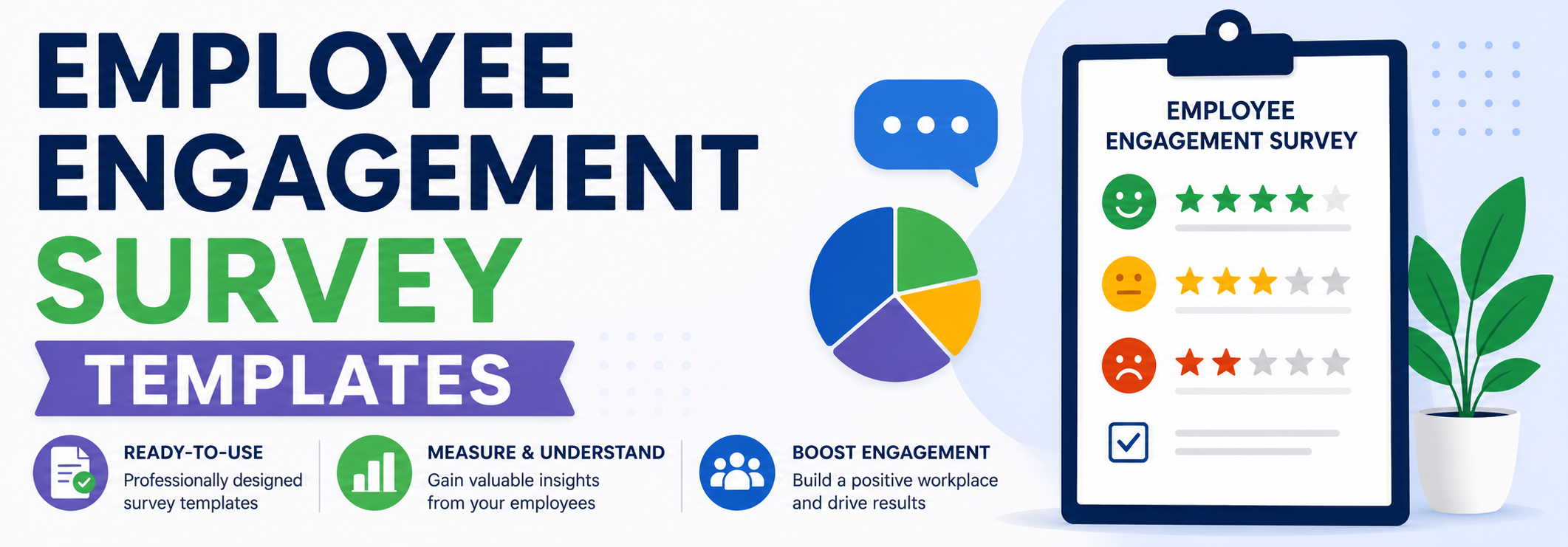
Question libraries save time and improve quality. However, they should not force generic surveys.
A good tool should offer evidence-based templates while allowing customisation for Indian teams, global teams, business units, and role-specific realities.
Actionable Alerts and Follow-Ups
A platform should help leaders act. Alerts may highlight sharp score drops, low psychological safety, high burnout risk, or poor manager alignment.
Follow-up workflows help assign owners, track progress, and close the loop.
Mobile-Friendly Interfaces
In India and many SEA and MENA markets, mobile access is essential. Employees may not always complete surveys on laptops. A mobile-friendly interface improves participation and inclusion, especially for frontline, field, school, retail, healthcare, logistics, and distributed teams.
Pulse Survey vs Engagement Survey: What Should You Use?
A pulse survey and an engagement survey serve different purposes.
The right approach is usually both: a deeper engagement survey once or twice a year, supported by targeted pulse surveys throughout the year.
For example, an Indian technology company might run a full engagement survey in April, then pulse surveys after appraisal cycles, manager development interventions, AI workflow changes, and hybrid work policy updates.
How Feedback Tools Support Organisational Growth
Feedback tools support growth by helping organisations scale culture intentionally.
When a company is small, founders and leaders can sense culture directly. They know who is energised, who is frustrated, and where communication is breaking down.
As the company grows, this becomes harder. New locations, new managers, new layers, and new business units create culture variation. What worked at 200 employees may break at 2,000. What worked in India may not translate exactly to the UK, US, SEA, or MENA.
Employee feedback tools support growth in four ways.
First, they provide visibility. Leaders can see where culture is strong and where it is fraying.
Second, they create consistency. Every team gets a structured listening channel.
Third, they improve leadership accountability. Culture becomes measurable and discussable.
Fourth, they help organisations act before problems become expensive.
This is especially relevant for companies scaling across regions. A global capability centre in India may need different engagement actions from a client-facing team in Dubai or a product team in London. A good feedback platform helps leaders preserve one culture while responding to local realities.
Metrics That Matter
Many organisations track too many metrics and act on too few. A practical engagement dashboard should include metrics that leaders can understand and influence.
Metrics should not be viewed in isolation. For example, engagement may look stable while workload sustainability falls. That suggests employees are still committed but may be at risk of burnout. Recognition may be high while career growth is low, suggesting employees feel appreciated but not developed.
The best leaders read patterns, not just numbers.
Examples of Employee Feedback Tools Worth Considering in 2026
The following platforms are mentioned as brands worth considering, not as a ranking or legal comparison. Product capabilities, pricing, and suitability change over time, so organisations should evaluate each option based on current needs, demos, security requirements, integrations, and regional support.
Enculture
Enculture is a culture intelligence platform built around a diagnostic-first, outcome-driven approach. It is designed to help organisations move from feedback collection to culture clarity and action.
Where many tools focus heavily on survey administration, Enculture’s positioning is around understanding culture signals, separating signals from noise, and helping leaders move from insight to action.
Key features and strengths may include:
- Culture diagnostics
- Engagement and pulse surveys
- Culture analytics
- Insight-to-action workflows
- Manager and leadership visibility
- Outcome-oriented reporting
- Culture health check capability
- Focus on retention, performance, recognition, and manager effectiveness
- Practical dashboards for HR and business leaders
Enculture is especially relevant for organisations that want more than survey scores. It suits teams looking to understand culture health, identify root causes, and support leaders with clear next steps.
The important distinction is that Enculture should not be seen as “just another survey tool”. Its stronger role is as a culture intelligence layer: diagnostic-first, insight-led, and designed to help HR and leadership teams make better people decisions.
Qualtrics Employee Experience
Qualtrics is known for enterprise-grade experience management and sophisticated survey design. It is often considered by large organisations that need advanced research capabilities, analytics, and customisation.
Key features commonly associated with platforms in this category include advanced survey logic, employee lifecycle listening, dashboards, text analytics, and experience data integration.
Culture Amp
Culture Amp is widely known in the employee engagement and people science space. It is often considered by organisations looking for engagement surveys, benchmarks, performance, and employee development features.
Its appeal is typically strongest for companies that want structured people science, survey templates, and broad employee experience insights.
Workday Peakon Employee Voice
Workday Peakon Employee Voice is positioned around continuous listening and real-time insights. Workday describes it as a way to maximise engagement, satisfaction, and productivity using real-time insights.
It may suit organisations already using Workday or those looking for enterprise employee voice capabilities.
Microsoft Viva Glint
Microsoft Viva Glint is often relevant for organisations already invested in the Microsoft ecosystem. It supports employee listening, engagement insights, and manager-focused action.
It may be useful where collaboration and productivity tools are already centred around Microsoft 365.
Leapsome
Leapsome is often considered by mid-market and growth-stage organisations looking to connect engagement, performance, OKRs, feedback, and learning.
It may appeal to companies that want people enablement workflows alongside surveys.
Officevibe
Officevibe is often considered by small and mid-sized teams that want lightweight pulse surveys, manager feedback, and team engagement insights.
It may be useful for teams that need simplicity and fast adoption.
15Five
15Five is commonly associated with performance management, check-ins, engagement, and manager enablement.
It may suit organisations that want to connect engagement conversations with performance routines.
Lattice
Lattice is often considered for performance management, engagement, goals, and employee development.
It may appeal to organisations looking for an integrated people success platform.
SurveyMonkey
SurveyMonkey may be considered by teams needing flexible survey creation. However, organisations looking for deep engagement diagnostics and culture analytics may need additional interpretation, action planning, and HR-specific workflows.
Tool Comparison Table
This table is not a ranking. It is a decision guide to help HR and business leaders think clearly about fit.
For Enculture, the strongest fit is an organisation that wants culture intelligence rather than only survey operations. This includes companies asking questions such as: How do we measure culture? How do we improve retention and performance through culture? Which engagement drivers matter most in our context? Where are managers creating or weakening culture? What actions should leaders take first?
How to Compare Employee Feedback Tools
Choosing a tool should not start with features. It should start with the problem you are trying to solve.
A CHRO may need board-level culture visibility. An HRBP may need business-unit diagnostics. A CEO may need trust and alignment insights. Managers may need simple team-level action guidance. Employees need a safe and credible way to be heard.
Use this comparison framework.
1. Diagnostic Depth
Can the tool identify root causes, or does it only show scores?
A mature platform should help answer why engagement is high or low. It should identify drivers such as manager effectiveness, recognition, workload, growth, trust, inclusion, or alignment.
2. Actionability
Does the platform help leaders act?
Dashboards are useful, but action guidance is better. Look for prioritisation, recommended actions, ownership tracking, manager toolkits, and follow-up workflows.
3. Confidentiality and Trust
Does the tool protect employee anonymity and communicate privacy clearly?
Without trust, response quality drops.
4. Regional and Cultural Fit
Can the platform support Indian English, regional nuance, global teams, and culturally sensitive survey design?
For India, questions should reflect realities such as career growth expectations, manager dependence, appraisal cycles, hybrid work, family considerations, learning aspiration, and distributed delivery models.
5. Analytics Quality
Can the tool analyse comments, trends, segments, and drivers?
Good analytics should help leaders separate signals from noise.
6. Integration
Does the tool connect with HRIS, performance, learning, recognition, collaboration, or communication systems?
Integration makes insights more useful.
7. Manager Usability
Can managers understand and use the results?
A tool that only HR can interpret will not scale culture change.
8. Implementation Effort
How long does setup take? How much internal capability is required? What support is available?
The best tool is not the one with the longest feature list. It is the one your organisation will actually use well.
Key Factors to Consider Before Choosing a Tool
Before selecting the best employee engagement survey software for your organisation, ask these questions.
The most important question is: “What will we do differently because of this tool?”
If the answer is unclear, pause before launching.
Implementation and Adoption Best Practices
A strong survey tool can still fail if implementation is weak. Adoption depends on trust, simplicity, leadership alignment, and visible action.
Start with Leadership Alignment
Before launching a survey, align the leadership team on purpose. Are you measuring engagement, culture, manager effectiveness, wellbeing, retention risk, or change readiness?
Leaders should agree on how results will be used and what level of transparency will follow.
Communicate Clearly to Employees
Employees should know:
- Why the survey is being conducted
- Whether responses are anonymous or confidential
- How data will be analysed
- Who will see results
- What action will follow
- When they will hear back
Clarity improves participation and trust.
Keep Surveys Focused
Do not ask everything. Ask what you are prepared to act on.
A good engagement survey balances core drivers with timely business questions.
Use the Right Cadence
A practical cadence may look like this:
Train Managers Before Sharing Results
Do not simply send dashboards to managers. Train them to interpret data, discuss results with teams, choose actions, and avoid defensiveness.
Managers need scripts and support. For example:
“Here are two things the team said are working well. Here are two areas where we need to improve. I would like us to discuss what one change would make the biggest difference over the next 30 days.”
Close the Loop
Closing the loop is the most important adoption behaviour.
Leaders should communicate:
- What we heard
- What we are prioritising
- What we cannot change immediately
- What we will review next
- How progress will be measured
Employees do not expect every issue to be solved instantly. They do expect honesty.
From Insight to Action: Turning Survey Results into Culture Change
The hardest part of engagement work is not survey design. It is action.
A practical insight-to-action model includes six steps.
1. Diagnose
Look beyond overall scores. Identify drivers, outliers, comments, segments, and business context.
2. Prioritise
Pick two or three priorities. Do not attempt to solve everything at once.
3. Translate
Convert survey themes into behavioural actions. For example, “low recognition” becomes “managers will give specific appreciation in weekly meetings and document recognition in team channels.”
4. Assign Ownership
Every action needs an owner. Some actions belong to HR. Some belong to managers. Some require leadership decisions.
5. Communicate Progress
Employees should hear updates, even when work is incomplete.
6. Measure Again
Use pulse surveys or targeted follow-ups to see whether action is working.
This is where Enculture’s culture intelligence approach becomes relevant. By focusing on diagnostics, signal clarity, metrics that matter, and insight-to-action, Enculture can help organisations avoid the common trap of collecting engagement data without changing employee experience.
The goal is not to make survey scores look better. The goal is to make work better.
Final Thoughts
The benefits of employee engagement survey programmes are strongest when organisations treat surveys as a leadership system, not an HR activity.
The employee engagement survey purpose is to understand what drives commitment, performance, trust, and retention. The purpose of employee engagement surveys is also to make culture visible enough to improve it. The value of employee engagement surveys lies in better decisions, sharper priorities, stronger managers, and employees who believe their voice matters.
In 2026, organisations cannot afford to manage culture by instinct. AI, hybrid work, generational shifts, wellbeing pressure, distributed teams, and rising talent expectations have made employee listening essential.
For Indian organisations and global teams with India as a major talent hub, engagement surveys are not merely a best practice. They are a practical way to improve retention, manager quality, productivity, recognition, and culture health.
Enculture fits into this future as a culture intelligence platform for organisations that want to move beyond survey collection. Its role is strongest where leaders want diagnostic depth, culture analytics, signal clarity, and a clear path from insight to action.
The best survey strategy is simple in principle and disciplined in practice: listen carefully, interpret honestly, act visibly, and keep improving.
FAQs
What are the benefits of employee engagement surveys?
The main benefits of employee engagement surveys include better retention, stronger manager effectiveness, improved communication, higher trust, better recognition, reduced burnout risk, sharper people analytics, and more data-driven culture decisions. They help leaders understand what employees need to perform and stay.
What is the employee engagement survey purpose?
The employee engagement survey purpose is to measure the conditions that influence employee commitment, motivation, performance, and intent to stay. It helps organisations identify what is working, what is blocking performance, and what leadership actions should be prioritised.
Why is employee engagement survey importance increasing in 2026?
Employee engagement survey importance is increasing because workplaces are changing quickly. AI, hybrid work, distributed teams, wellbeing pressure, and rising employee expectations make it harder for leaders to understand culture through observation alone. Surveys provide structured, timely insight.
How often should companies run engagement surveys?
Most organisations should run a deep engagement survey once or twice a year and support it with shorter pulse surveys quarterly, monthly, or after major changes. The right cadence depends on business pace, employee trust, and leadership readiness to act.
What is the difference between a pulse survey and an engagement survey?
An engagement survey is a deeper diagnostic tool that measures core engagement drivers. A pulse survey is shorter and more frequent, designed to track sentiment or specific themes over time. Most organisations need both.
Are employee engagement surveys anonymous?
They can be anonymous or confidential, depending on the platform and survey design. What matters most is employee trust. Employees should clearly understand who can see results, how anonymity is protected, and how the data will be used.
How do engagement surveys improve retention?
Engagement surveys improve retention by identifying early warning signs such as low career clarity, weak recognition, poor manager support, unsustainable workload, low trust, and limited growth opportunities. Leaders can then take targeted action before employees leave.
What questions should an employee engagement survey include?
A strong survey should include questions on manager effectiveness, recognition, career growth, workload, psychological safety, inclusion, leadership trust, alignment, wellbeing, and intent to stay. The best questions are clear, actionable, and linked to business priorities.
What is a culture health check?
A culture health check is a structured assessment of whether an organisation’s values, behaviours, leadership practices, and employee experiences are healthy and aligned. It helps leaders identify culture strengths, risks, and priority actions.
How can companies improve engagement after a survey?
Companies can improve engagement by sharing results transparently, prioritising two or three themes, involving managers, creating action plans, communicating progress, and measuring again. The most important step is closing the feedback loop.
What is the best employee engagement survey software?
There is no single best employee engagement survey software for every organisation. The right choice depends on company size, culture goals, analytics needs, integrations, regional requirements, and action-planning maturity. Enculture, Qualtrics, Culture Amp, Workday Peakon, Microsoft Viva Glint, Leapsome, Lattice, 15Five, Officevibe, and SurveyMonkey are examples of brands worth evaluating, not a ranking.
How does Enculture support employee engagement surveys?
Enculture supports employee engagement surveys by approaching them as part of culture intelligence. It focuses on diagnostics, culture analytics, signal versus noise, metrics that matter, and moving from insight to action. This helps leaders understand not only what employees feel, but what to do next.
From mental health support to career development opportunities, this checklist ensures you're not missing critical elements that impact employee satisfaction. Includes assessment criteria, scoring guidelines, and prioritization framework to turn insights into action.
Get Free AccessRead Our Other Blogs

See what our customers are saying
Implementation was handled well. Their team guided us and helped in resolving the challenges. We were able to gather insights that identified cultural risk factors..


See what our customers are saying
What impresses me most is how intuitive the platform is. Our teams quickly embraced the tools, resulting in a very high survey completion rate. The actionable data has driven tangible improvements company-wide. We are happy to explore other offerings from the platform.
Access exclusive resources today
Frequently asked questions
Explore our frequently asked questions to learn more about Enculture’s features, security, integration capabilities, and more

Enculture combines strategic HR consulting expertise with advanced technology to provide a consultative approach rather than a purely product-led experience. This tailored method ensures that our solutions are specifically aligned with each company’s unique culture and objectives.
Through in-depth analytics and sentiment tracking, our platform can highlight areas where employees may be disengaged or dissatisfied, enabling proactive action. Identifying these risks early helps prevent issues like increased turnover or declining productivity.
We turn data into clear, practical steps. Enculture provides HR leaders with data-driven recommendations and dashboards that pinpoint where to focus efforts, enabling organizations to act on survey feedback effectively.
Our platform offers highly customizable survey templates and tools, allowing HR teams to tailor questions to their unique organizational needs and goals. This flexibility ensures that the insights are relevant and actionable for your specific workplace environment.
Enculture is designed to scale with your organization. As your culture and engagement needs evolve, our platform’s flexibility and customization options allow it to adapt seamlessly to new challenges and goals.
.svg)